The UAE Isn’t a Destination. It’s a Portfolio.
The UAE Isn’t a Destination. It’s a Portfolio.
Seven emirates. Seven risk-return profiles. One shared balance sheet of airlines, visas and brand equity.
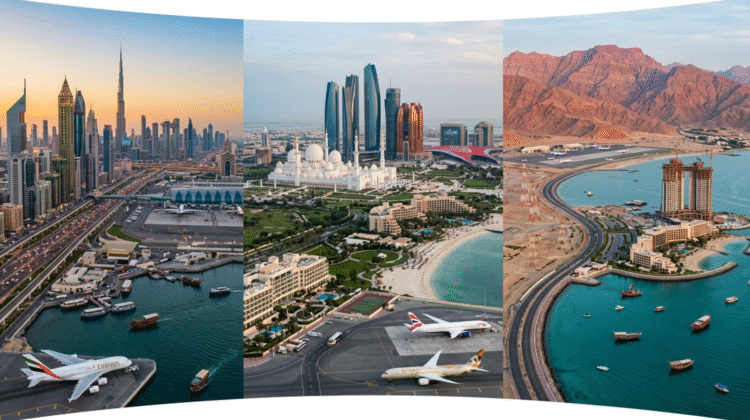
Ask an economist to describe the UAE’s tourism strategy and the language that fits isn’t “destination marketing” — it’s portfolio construction. Seven emirates, each running a different risk-return profile, sharing the same currency, the same open skies, the same visa ecosystem, and the same national brand. Dubai is the liquid large-cap index: massive scale, deliberately diversified across nationalities so no single source-market downturn can move the whole portfolio. Abu Dhabi is the yield play, sacrificing raw visitor count for margin. Ras Al Khaimah is the emerging-market growth bet, small base, high beta, backed by a single enormous capital project. And the tourism sector underneath all of it isn’t a side business — it’s forecast to contribute roughly AED 267.5 billion, nearly 13% of UAE GDP, and support more than 925,000 jobs in 2025 alone, according to WTTC’s Economic Impact Research. That’s not a rounding error in the national accounts. It’s core economic infrastructure, sliced seven different ways.
Massive scale and deliberately diversified source markets reduce concentration risk.
A smaller guest base built around stronger revenue, rate and RevPAR performance.
A smaller base with high beta, new air access and a major capital project.
Distinct positioning rather than direct competition with Dubai’s scale model.
Dubai: Diversification as a Defensive Asset
Dubai’s real advantage was never the visitor count — it’s the correlation structure. The emirate welcomed 19.59 million international overnight visitors in 2025, up 5% on 2024’s 18.72 million, with hotel occupancy at 80.7% and room nights up 4% to 44.85 million, per the Dubai Department of Economy and Tourism. But the more interesting number is the source mix: Western Europe at 21%, GCC and MENA at 26%, with the rest spread across CIS, South Asia, East Asia and the Americas. No single market is large enough to sink the portfolio if it has a bad year — Dubai has effectively engineered itself out of the concentration risk that defines most single-country tourism economies, the way an index fund is engineered to survive any one constituent stock’s collapse.
Abu Dhabi: The Yield Trade
Abu Dhabi is running the opposite trade — deliberately, and for now, successfully. Hotel guests grew a modest 2.2% to 5.9 million in 2025, a fraction of Dubai’s number. But hotel revenue jumped 19.5% to AED 9.1 billion, average daily rate rose 19%, and RevPAR — the single number that tells you whether a hotel market is actually getting more valuable, not just busier — climbed 23%, according to the Department of Culture and Tourism – Abu Dhabi. That’s a market extracting far more revenue per visitor rather than chasing more visitors, full stop. India alone delivered 436,124 hotel guests, up 22%, ahead of Russia, the UK and China. Worth flagging for anyone modelling off this data: Abu Dhabi also reports 26.6 million total visitors when day-trippers and other categories are included — “visitor” and “hotel guest” are not interchangeable units across emirates, and any cross-emirate comparison has to be read with that distinction in mind.
Hotel guests: +2.2% | Hotel revenue: +19.5% | ADR: +19% | RevPAR: +23%
The 2025 print is strong, but it shouldn’t be read as proof the yield strategy is immune to shocks. Since late February 2026, the wider region has absorbed a serious external one: the conflict involving the US, Israel and Iran closed UAE airspace for a period, forced a wave of carrier suspensions — British Airways pulled Abu Dhabi service for the remainder of the year, Virgin Atlantic ended its Dubai season early, Singapore Airlines and Cathay Pacific suspended UAE routes into the summer — and, by several accounts, brought strikes near UAE airports and tourist areas. Networks have been rebuilding through the summer, with Emirates reported at roughly three-quarters of its pre-conflict schedule as of early August, but full capacity hasn’t returned. This matters more for Abu Dhabi’s model than for Dubai’s: a yield strategy depends on holding rate against a smaller guest base, which leaves less room to absorb an international-arrivals shock than a high-volume, high-diversification model built to shrug off exactly that kind of disruption. Whether 2026’s RevPAR gains hold will depend less on discretionary spending than on how quickly premium long-haul capacity — the segment that actually pays Abu Dhabi’s rates — comes back online.
Ras Al Khaimah: The High-Beta Growth Bet
Ras Al Khaimah is the one worth actually underwriting, not just admiring. 1.35 million overnight visitors in 2025, up 6%, with tourism revenue growing faster still at 12% — the classic signature of a market still working out how to monetise its own growth, per RAKTDA’s year-end release. The source-market data is the real signal: India up 14%, China up 19%, Russia up 20%, and smaller but faster-growing corridors — Romania up 41%, Poland up 22% — opening on the back of new direct routes RAK’s own aviation authority negotiated rather than inherited. That’s not organic tourism drift; it’s a destination actively building its own bilateral air access the way a growth-stage company builds distribution. The real option sitting on top of all of it is Wynn Al Marjan Island — a $5.1 billion integrated resort due in 2027, over 1,500 rooms, and more than 9,000 jobs attached, with its 70-storey tower already topped out. It’s worth being precise about what kind of bet this is: it’s the UAE’s first legal gaming license, a genuine regulatory departure from the framework that governs capital projects everywhere else in the country. That’s not a minor footnote — it re-prices RAK’s entire trajectory toward its stated target of 3.5 million visitors by 2030 on the back of a demand category (gaming tourism) that doesn’t really exist anywhere else in the portfolio, for better or worse.
Overnight visitors: 1.35m | Visitor growth: +6% | Tourism revenue: +12% | Wynn Al Marjan Island: $5.1bn
Sharjah and the Specialist Emirates
Sharjah and the three smallest emirates aren’t failing to compete with Dubai — they’ve correctly priced themselves out of that competition. Sharjah’s positioning — proximity to Dubai’s demand without Dubai’s price point, anchored by a genuinely useful international airport — is a value strategy, not a consolation prize, and it’s worth remembering tourism isn’t even carrying the weight there: Sharjah’s economy leans heavily on manufacturing, logistics and free-zone trade, which means its comparatively modest visitor volume is structurally beside the point rather than a shortfall to be corrected. Fujairah, Ajman and Umm Al Quwain are running the tourism equivalent of a specialist fund rather than trying to out-scale an index: mountains and coastline, family affordability, low-density nature tourism. None of them need Dubai’s visitor volume to be economically rational bets, because none of them are trying to win the same competition.
The Real Asset: What the Visitor Eventually Becomes
The genuinely important economics, though, sit one layer beneath all seven visitor counts. A tourist arrival isn’t the end of the transaction — it’s the first rung of a longer capital-allocation ladder. Visitor arrives, books a hotel, generates airline demand, spends on retail, gets exposed to the business environment, considers relocating a subsidiary, looks at a residency visa, eventually looks at property. Each stage converts a fraction of the one before it, and each conversion is downstream capital finding its way into the country through a channel that started as a hotel booking. Seen this way, an incentive like a complimentary visa bundled with a hotel stay isn’t a tourism discount at all — it’s a loss-leader underwritten by the state to secure longer-run FDI and capital inflow, priced on the bet that an Indian visitor who eventually buys property or relocates a business is worth far more over time than the fee waived on arrival. India’s position atop nearly every emirate’s growth numbers — Abu Dhabi’s largest hotel-guest market, Dubai’s largest single South Asian contributor, RAK’s fastest-scaling major corridor — means that spillover is currently running hardest through a single nationality, which is itself worth watching: the UAE has diversified beautifully across emirates, but its highest-growth demand pipeline increasingly runs through one origin market.
Visitor → Hotel → Airline demand → Retail spend → Business exposure → Relocation consideration → Residency → Property / FDI
The Investment Question
For anyone allocating capital, routes or marketing spend against “the UAE,” the operating question was never which emirate wins. It’s which risk-return profile matches what you’re actually trying to build: Dubai’s liquidity and diversification, Abu Dhabi’s yield (now being tested by a live external shock rather than a cyclical one), RAK’s growth optionality, or Sharjah’s value defensiveness. Seven emirates, seven strategies, one shared balance sheet of airlines, visas and brand equity — and increasingly, one shared bet that the real return isn’t the visitor at all. It’s the capital that visitor eventually brings with them.
This report is part of TheTravigator’s continuing news coverage of the travel, tourism, aviation, and hospitality sectors. Our editorial team publishes industry news, market insights, partnerships, policy developments, and business updates relevant to the travel trade community. For press releases, partnership opportunities, advertising enquiries, or editorial collaborations, please contact our editorial desk at:
INFO@THETRAVIGATOR.COM