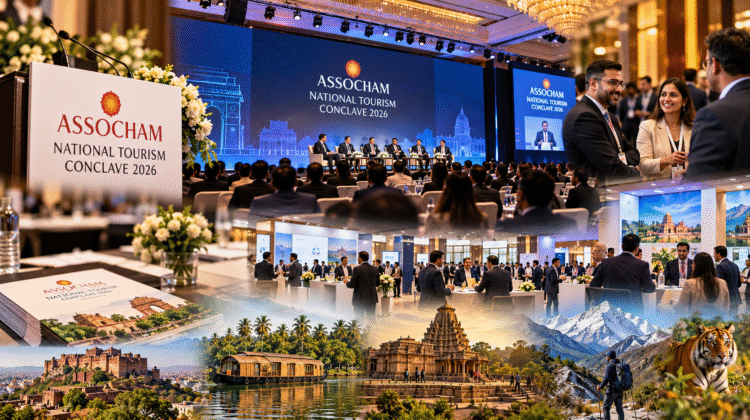
The ASSOCHAM National Tourism Conclave 2026
The ASSOCHAM National Tourism Conclave 2026: India’s $1 Trillion Tourism Dream Takes Centre Stage
New Delhi, 30 September 2026 — If there was one unmistakable takeaway from the ASSOCHAM National Tourism Conclave 2026, it was this: India’s tourism sector has stopped asking whether it can become an economic engine and started asking how fast it can get there.
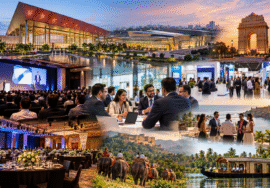
Held at the Hotel Shangri-La Eros in the heart of the capital, the one-day conclave—themed “Tourism as an Economic Engine: Technology, Policy, Investment & Global Partnerships”—drew an impressive cross-section of government heavyweights, hospitality leaders, investors, and travel-tech innovators. The timing could not have been more pointed. With India’s organised hotel sector posting its strongest post-pandemic numbers and the government’s Viksit Bharat 2047 ambition gathering pace, the industry finds itself at an inflection point that demands both celebration and cold-eyed realism.
A Ministerial Mandate for Private Investment
The inaugural session set the tone. Shri Gajendra Singh Shekhawat, Hon’ble Minister for Tourism and Culture, Government of India, wasted no time in framing tourism as mission-critical to India’s developmental goals. Future growth, he argued, hinges on three non-negotiables: building new destination experiences, boosting private sector investment, and dramatically improving destination management. The message was clear—government can facilitate, but industry must deliver.
The Minister’s address was preceded by a series of sharp industry interventions. Shri Nirmal Kumar Minda, President of ASSOCHAM, welcomed delegates with a call for cohesive action. Shri Ravi Gosain, President of the Indian Association of Tour Operators, brought the inbound operator’s perspective to the fore, while Dr Subi Chaturvedi of InMobi offered a glimpse into how data and digital ecosystems are rewriting the rules of visitor engagement. Shri P Balaji of Air India, chairing ASSOCHAM’s National Civil Aviation Council, underscored the critical aviation-tourism nexus that remains central to any growth narrative.
The Numbers That Matter: CBRE Report Sets the Benchmark
The release of the ASSOCHAM-CBRE joint knowledge report was arguably the morning’s most anticipated moment. And it did not disappoint.
According to the findings presented by knowledge partner CBRE India, organised hotel occupancy surged to 64.1% in 2025, a dramatic climb from the 42.0% recorded in 2021. More significantly, Revenue Per Available Room (RevPAR) has now fully surpassed pre-pandemic levels—a milestone that signals genuine pricing power returning to the sector after years of discount-driven recovery.
But the report’s real value lay in its identification of high-growth verticals ripe for investment: spiritual tourism, MICE, wellness, cruise, rural, and wildlife tourism. These, the report argued, represent the next frontier for capital deployment, moving beyond the traditional metro-centric hotel model into experience-rich, community-embedded destinations that can distribute tourism’s economic benefits far more equitably.
Technology Moves from Novelty to Necessity
Shri Saurabh Sanyal, Secretary General of ASSOCHAM, captured the technological shift with characteristic precision. Artificial Intelligence, the Internet of Things, and digital booking bots, he noted, are “shifting from novelty to necessity”—forming the baseline framework for destination discovery, visitor management, and customer feedback optimisation. The message to industry laggards was unmistakable: digital adoption is no longer a competitive advantage; it is table stakes.
This theme echoed through the day’s panel discussions, particularly the session on “Smart Tourism: AI, Digital Platforms & the Future of Travel Experience,” which explored facial authentication, multilingual content, and experiential storytelling while cautioning against privacy and inclusion pitfalls.
States as Investment Frontlines
If the national narrative provided the vision, the states brought the specifics. Dr. Arvind Kumar Sharma, Hon’ble Cabinet Minister for Co-operation, Jails, Elections, Heritage & Tourism, Government of Haryana, used the platform to pitch immediate private investment opportunities in culture-heavy zones like Kurukshetra, Pinjore, and Surajkund. His presence—and the day’s dedicated state showcase sessions for West Bengal and Delhi—signalled a welcome shift: tourism is no longer a Centre-only conversation. States are competing for capital, and the conclave provided the marketplace.
Haryana highlighted private investment opportunities around Kurukshetra, Pinjore and Surajkund, while dedicated state showcase sessions brought West Bengal and Delhi into the investment conversation.
The $1 Trillion Question
The day’s five panel discussions, spread across the morning and afternoon, tackled the hard questions:
Can tourism become one of India’s next major economic growth engines?
Panellists from the Ministry of Tourism, MHA, FAITH, and leading private operators debated the structural shifts required—ease of doing business, visa facilitation, integrated connectivity, and central-state coordination—to move tourism from potential to national priority.
Can India become a global tourism powerhouse—from Incredible India to Indispensable India?
This session examined destination branding, international marketing networks, and the need to attract high-value, long-stay visitors. The presence of Shri Suman Billa, Additional Secretary and Director General (Tourism), lent weight to discussions on Centre-State-industry coordination.
Where will the next ₹1 lakh crore of tourism investment come from?
Perhaps the day’s most consequential conversation. Moderated by CBRE’s Vamshi KK Nakirekanti, panellists from Radisson, the National Infrastructure and Investment Fund, IFC, and West Bengal’s tourism directorate explored FDI, domestic private equity, sovereign capital, and innovative financing platforms. The consensus: bankability, land availability, policy certainty, and PPP frameworks remain the critical bottlenecks. The conversation went beyond large hotels to embrace homestays, Self-Help Groups, and community-led enterprises—a recognition that inclusive growth is not just a moral imperative but an economic multiplier.
India’s Event Economy: Can Our Cities Keep Pace?
With concerts and live events driving unprecedented tourism demand, panellists from the Ministry of Information and Broadcasting, E-Factor Experiences, Serendipity Arts Foundation, and ICE Events deliberated on policy imperatives for building a sustainable event ecosystem.
FDI, domestic private equity, sovereign capital and innovative financing platforms were placed alongside the industry’s continuing challenges around bankability, land availability, policy certainty and PPP frameworks.
The Road Ahead
As delegates filed out of the Shangri-La’s conference halls and into the Delhi evening, the mood was one of cautious optimism. The data supports ambition: occupancy is up, RevPAR is healthy, and investor interest is genuine. But the conclave also laid bare the gaps—in infrastructure, in policy coherence, in the sheer scale of capital mobilisation required to hit the $1 trillion target by 2047.
What emerged most clearly is that India’s tourism transformation will not be led by any single stakeholder. It will require the Centre and states to move in lockstep, the private sector to embrace technology and sustainability, and the financial ecosystem to structure products that match the sector’s unique risk-return profile.
The ASSOCHAM National Tourism Conclave 2026 did not provide all the answers. But by convening the right people, asking the right questions, and releasing data that grounds aspiration in reality, it has done something arguably more valuable: it has created a shared roadmap.
For an industry that has spent the better part of a decade recovering from exogenous shocks, that sense of collective direction may prove to be the most valuable takeaway of all.
This report is part of TheTravigator’s continuing news coverage of the travel, tourism, aviation, and hospitality sectors. Our editorial team publishes industry news, market insights, partnerships, policy developments, and business updates relevant to the travel trade community. For press releases, partnership opportunities, advertising enquiries, or editorial collaborations, please contact our editorial desk at:
INFO@THETRAVIGATOR.COM