India’s MICE Opportunity: Turning Convention Capacity into Global Business
India’s MICE Opportunity: Turning Convention Capacity into Global Business
MICE—Meetings, Incentives, Conferences and Exhibitions—connects tourism with commerce, professional networks and investment. For India, its value extends beyond hotel occupancy: business events bring buyers to industrial clusters, attract international expertise and generate opportunities for destination management companies, event agencies and local suppliers.
India has strengthened its hosting proposition. The question now is how effectively it can translate that capacity into confirmed events, international delegates and repeat business.
How much MICE business is India doing?
One recent industry estimate values India’s MICE market at US$49.4 billion in 2024, with a projection of US$103.7 billion by 2030. These figures were cited by the president of the Indian Exhibition Industry Association in a Ministry of Tourism release dated 19 December 2025. They are industry estimates and forecasts, rather than audited government revenue or guaranteed future outcomes.
This distinction matters because MICE market studies measure different combinations of event expenditure, travel, accommodation and wider economic activity. Their totals should not be combined or presented as directly comparable.
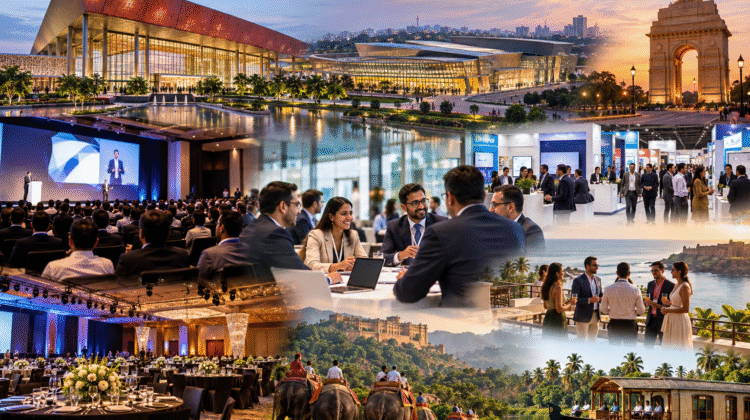
On infrastructure, the Ministry highlights Bharat Mandapam and Yashobhoomi in Delhi and major modern venues in Mumbai as important assets. National promotion has also become more structured: in February 2026, the government confirmed the introduction of “Meet in India” within Incredible India and the circulation of guidelines for city MICE promotion bureaus.
For the travel industry, this creates a stronger platform. However, venue capacity alone cannot measure business performance. Confirmed events, delegate nights, local spending and repeat bookings provide a more meaningful picture.
Which Indian states are focusing on MICE?
State commitment is best assessed through specific policies, institutional support, buyer outreach and infrastructure investment. These measures demonstrate focus, although they do not establish a ranking of state MICE revenues.
Infrastructure commitments extend beyond these states. A Ministry of Tourism parliamentary reply dated August 2025 lists several sanctioned projects:
| State | Sanctioned project | Listed cost |
|---|---|---|
| Madhya Pradesh | International Convention Centre for MICE | ₹99.38 crore |
| Gujarat | Tented City and Convention Centre | ₹51.56 crore |
| Arunachal Pradesh | Siang Adventure and Eco-Retreat, Pasighat, including a convention centre | ₹46.48 crore |
All three were sanctioned in 2024. These are project costs, sometimes covering broader tourism infrastructure—not annual MICE budgets, completed expenditure or proof that facilities are operational.
The same parliamentary reply identifies convention-related projects in Goa, Haryana, Himachal Pradesh and Mizoram, among other states and territories. The geographic spread shows that convention development is reaching beyond the largest metropolitan destinations.
Delhi, a Union Territory, deserves separate recognition for the major venues highlighted by the Ministry. This overview is illustrative rather than an exhaustive state ranking.
Which countries are Indian companies targeting?
The strongest evidence reviewed identifies the United Arab Emirates, Thailand and Singapore as important destinations for Indian outbound MICE. It does not establish a definitive nationwide ranking by corporate expenditure or delegate volume.
Thailand’s buyer targeting also reveals which Indian industries it sees as promising. Its August 2025 roadshow in Hyderabad and Bengaluru explicitly highlighted IT, software, pharmaceuticals and biotechnology.
These examples demonstrate demand across pharmaceutical, real-estate and corporate incentive segments. For organisers, destination selection should follow the programme’s purpose: employee rewards, dealer engagement, professional learning or customer development. Air access, visa processing, room availability, food requirements and total cost can be as decisive as the venue.
What is India’s future MICE prospect?
India’s prospects depend on turning its venues, business networks and destination experiences into a dependable event pipeline.
The government’s city-bureau framework could help coordinate venues, hotels, transport providers and public authorities. Its December 2025 announcement also set an ambition to double India’s global MICE market share within five years. This remains a policy objective, not an achieved result.
From a B2B perspective, four priorities stand out.
Cities should pursue events that match their industrial, academic and professional strengths, giving organisers a reason to choose the destination beyond its facilities.
Coordinated quotations, clear contracts, reliable transfers and efficient approvals can strengthen buyer confidence.
Cultural experiences, wellness, cuisine and nature can give Indian destinations compelling programmes around the business agenda.
Destinations should track confirmed events, delegate nights, local spending and repeat bookings alongside infrastructure development.
For hotels, DMCs and event agencies, the opportunity is to offer a coordinated experience covering accommodation, transport, production and post-conference travel. India’s MICE future will depend on how consistently its destinations deliver events that organisers want to book again.
This report is part of TheTravigator’s continuing news coverage of the travel, tourism, aviation, and hospitality sectors. Our editorial team publishes industry news, market insights, partnerships, policy developments, and business updates relevant to the travel trade community. For press releases, partnership opportunities, advertising enquiries, or editorial collaborations, please contact our editorial desk at:
INFO@THETRAVIGATOR.COM