India’s Asian Games Surge Puts Aichi-Nagoya on the Global Travel Map
India’s Asian Games Surge Puts Aichi-Nagoya on the Global Travel Map
The closing weekend of the Aichi-Nagoya Asian Games is delivering exactly the kind of sporting drama that turns an international event into a destination story.
As of October 2, India has surged into the top five of the medal standings, with its campaign gathering extraordinary momentum in the final phase of the Games. The Indian contingent has produced 16 gold, 25 silver and 35 bronze medals—76 podium finishes in all—across a broad range of disciplines.
For the travel industry, however, the numbers tell only part of the story.
The bigger narrative is the visibility that Aichi-Nagoya is receiving as a destination capable of hosting Asia’s largest multi-sport gathering while connecting multiple Japanese cities, venues and visitor experiences into one sporting ecosystem.
A Golden Friday Changes the Narrative
October 2 became a defining day for India, with six gold medals coming across archery, boxing, wrestling and hockey.
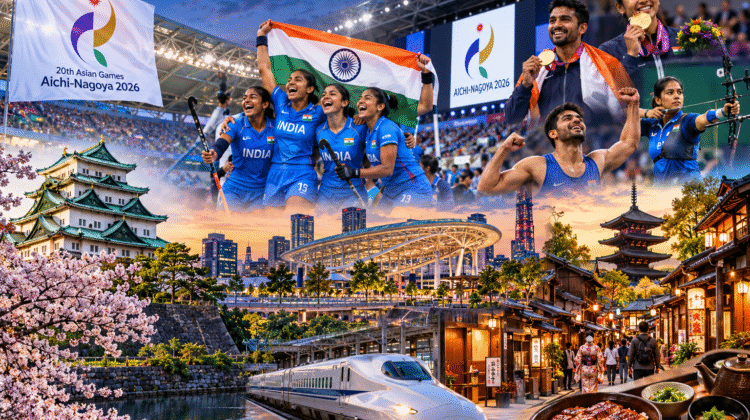
The sequence culminated in one of the most emotionally significant victories of the Games: India’s women’s hockey team defeated China 1-0 to win Asian Games gold for the first time since 1982. The result also secured the team a place at the 2028 Los Angeles Olympics.
Women’s hockey gold — India’s first Asian Games title in the event since 1982, alongside qualification for the 2028 Los Angeles Olympics.
For Japan’s visitor economy, moments such as these have an effect beyond the stadium.
Fans following Indian athletes have had reason to look beyond the competition venues towards Nagoya and the wider Aichi region—its food culture, rail connectivity, shopping districts, heritage attractions and business infrastructure. Sport creates the initial reason to travel; destination experiences determine whether that journey becomes a longer stay.
India’s Medal Story Is Remarkably Diverse
India’s performance has also avoided dependence on a single sporting discipline.
Archery has produced one of the Games’ standout stories, with Ankita Bhakat, Kumkum Mohod and Kirti Sharma winning India’s first Asian Games women’s recurve team gold, ending South Korea’s long dominance of the event.
Boxing has delivered another surge, including gold medals for Lovlina Borgohain and Parveen Hooda, while wrestler Sujeet Kalkal added another title.
Athletics, meanwhile, has provided considerable depth to the overall campaign, reinforcing the breadth of India’s sporting participation rather than concentrating attention around only its traditionally followed sports.
For travel planners, that diversity matters. Cricket may be the strongest commercial entry point for the Indian market, but a multi-sport event creates multiple audience segments—families, youth travellers, sports clubs, corporate groups, school and university communities and specialist fan communities.
The Business Opportunity Beyond the Medal Table
Aichi-Nagoya 2026 demonstrates why major sporting events increasingly belong on the radar of the business travel and tourism sectors.
The event has placed the region in front of millions of viewers across Asia at a moment when travellers are increasingly seeking experiences built around culture, entertainment and live events. For Japanese destination marketers and Indian travel businesses, that creates an opportunity to convert temporary sporting interest into future leisure demand.
The commercial opportunity extends from air connectivity and hotel stays to rail travel, MICE programmes, incentive trips, culinary tourism and pre- and post-event itineraries.
And the timing is significant. With the Games running through October 4, India’s final medal tally is still evolving.
Whatever the final number, the more enduring story may be the destination exposure generated along the way.
For India, Aichi-Nagoya has become a showcase of sporting ambition and breakthrough performances. For Japan, it has provided a high-profile international platform for Aichi and Nagoya—and a reminder to the global travel trade that the most powerful destination stories are often created when sport, culture, hospitality and human achievement meet in the same place.
The medals will eventually be archived. The travel memories may last considerably longer.
This report is part of TheTravigator’s continuing news coverage of the travel, tourism, aviation, and hospitality sectors. Our editorial team publishes industry news, market insights, partnerships, policy developments, and business updates relevant to the travel trade community. For press releases, partnership opportunities, advertising enquiries, or editorial collaborations, please contact our editorial desk at:
INFO@THETRAVIGATOR.COM