India’s Digital Tourism Stack
India’s Digital Tourism Stack: The Global Lessons That Could Make or Break the Big Bet
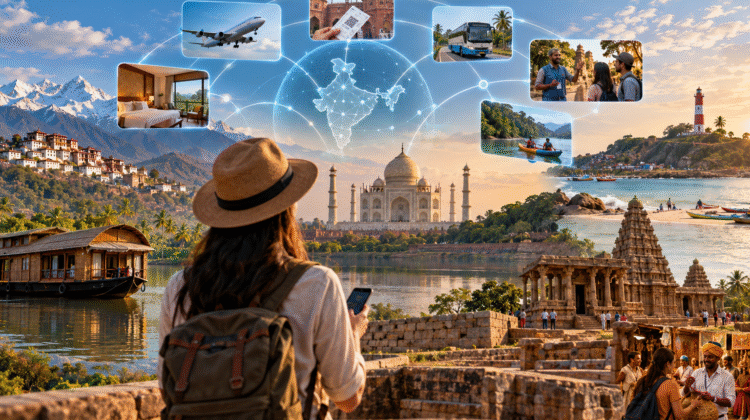
Tourism has always been an industry of connections. A traveller may book a flight on one platform, accommodation on another, a monument ticket elsewhere, hire a local guide through a social-media contact and discover a village experience only after reaching the destination. For the traveller, it is one journey. For the industry, it remains a collection of disconnected transactions.
That is the problem India’s National Digital Tourism Stack (NDTS) is attempting to address.
Launched by the Ministry of Tourism on September 27, 2026, the stack is being developed with ONDC and aims to create shared digital infrastructure through which tourism providers can make their offerings more discoverable, verifiable and accessible across participating platforms. Its proposed capabilities include supplier credentials, search and discovery, payments, ratings and grievance redressal. A pilot is planned for January 2027.
The ambition is considerable: bring 23,000 tourism offerings into the ecosystem by 2028, including homestays and local experiences. If executed well, NDTS could shift the competitive equation for thousands of small tourism businesses that today struggle to achieve digital visibility.
But India is not entering uncharted territory.
The Global Playbook
Singapore offers perhaps the most instructive case. The Singapore Tourism Board developed the Tourism Information & Services Hub (TIH) as a shared digital resource for tourism businesses, while its Singapore Tourism Analytics Network (Stan) brings together tourism data and analytical tools. Stan now offers visualisations, a data marketplace and a sandbox for collaborative analytics.
The lesson, however, is not simply that digital platforms work. It is that they must continuously evolve. Singapore ultimately discontinued TIH in July 2025 while streamlining its digital services. For India, that is an important warning: building a national platform is only the beginning. Governance, relevance, user experience and willingness to retire or redesign outdated components matter just as much.
Lesson: evolve or redesignSpain provides another useful model. Its Smart Tourism Destinations Network, established in 2019, connects destinations around a common methodology built around governance, sustainability, accessibility, innovation and technology. The objective is not merely to digitise tourism products but to change how destinations are managed.
Lesson: digitise destination managementMeanwhile, the European Tourism Data Space is tackling the problem at an even broader level: enabling trusted data sharing across businesses, destinations and public authorities. Its emerging experience highlights precisely the issues India will encounter—data fragmentation, interoperability, data quality and trust.
Lesson: trusted data sharingFive Things India Must Get Right
Make onboarding almost invisible
A homestay owner in a remote village should not need a technology consultant to join NDTS. Vernacular interfaces, assisted onboarding, voice-based tools and local training will be as important as APIs.
Make interoperability non-negotiable
India has states, municipalities, monument authorities, transport operators and private platforms operating different systems. “One ticket, one pass” will remain a slogan unless standards, APIs and governance mechanisms allow these systems to communicate reliably.
Build trust into the architecture
Tourism data can include commercially sensitive business information as well as personal traveller information. Singapore’s Data Trust Charter illustrates the importance of establishing clear rules around responsible data sharing. India will need equally strong privacy, consent, cybersecurity and accountability frameworks.
Measure economic outcomes—not registrations
The real KPIs should be incremental bookings for small operators, lower customer-acquisition costs, higher conversion, greater length of stay and increased tourism spend in emerging destinations. Twenty-three thousand listings will mean little if they generate no transactions.
Use data to manage destinations, not simply sell them
The greatest opportunity may lie beyond booking. Visitor-flow data can help governments identify congestion, redirect demand, manage carrying capacity and strengthen lesser-known destinations. This is precisely the direction emerging European tourism data initiatives are taking.
The Bigger Opportunity
NDTS should therefore not be viewed merely as another government tourism portal—or another distribution channel for OTAs.
Its bigger promise is to become digital public infrastructure for an industry that has historically operated in silos.
If India can combine ONDC-style interoperability with Singapore’s data discipline and Spain’s destination-management approach, NDTS could do something more consequential than simplify booking: it could change where tourism demand goes, who captures its economic value and how destinations manage growth.
The technology can provide the rails.
The real test, beginning in 2027, will be whether India can persuade millions of businesses, hundreds of institutions and an extraordinarily diverse tourism market to travel on them together.
This report is part of TheTravigator’s continuing news coverage of the travel, tourism, aviation, and hospitality sectors. Our editorial team publishes industry news, market insights, partnerships, policy developments, and business updates relevant to the travel trade community. For press releases, partnership opportunities, advertising enquiries, or editorial collaborations, please contact our editorial desk at:
INFO@THETRAVIGATOR.COM