
From Stadiums to Destinations: Why India’s Sports Boom Is Travel’s Next Big Play
From Stadiums to Destinations: Why India’s Sports Boom Is Travel’s Next Big Play
The medals make headlines. The ecosystem makes money. India’s sporting story is expanding in a direction the travel trade hasn’t fully priced in yet.
The ecosystem is becoming the story
The medals make headlines. The ecosystem makes money. That distinction is worth sitting with, because India’s sporting story is expanding in a direction the travel trade hasn’t fully priced in yet — and the runway is shorter than it looks: the 2026 Asian Games open in Aichi-Nagoya, Japan, on September 19, barely a week from now.
For decades, India’s relationship with sport was mostly spectatorship — cricket in the summer, hockey nostalgia in the winter, a quadrennial burst of Olympic hope. Medals, heroes, heartbreak. That narrative is genuinely widening. At the last Asian Games, in Hangzhou in 2023, India delivered its best-ever campaign: 107 medals, including 28 gold, finishing fourth overall across 22 sports — the first time the country had crossed 100 medals at any edition of the Asian Games specifically, and only the second time it had done so at any of the three major multi-sport Games, after the 101 medals it won on home soil at the 2010 Commonwealth Games in Delhi. The Aichi-Nagoya edition expands the programme to 43 sports and 71 disciplines, with more than 11,000 athletes from 45 nations expected. More athletes, more officials, more federations, more families travelling alongside them. But the more interesting commercial question for the travel trade isn’t the medal count. It’s what happens in the days around the competition.
Come to watch. Then come to play.
That’s where participation, not spectatorship, is quietly becoming the real story. A cricket bat and an open patch of ground are familiar across India in a way a proper badminton court or an archery range simply isn’t, and people don’t build a lasting relationship with a sport they’ve never had the chance to actually try. A destination with the right facilities can offer more than sightseeing — training camps, amateur tournaments, sporting clinics, wellness programmes built around an activity rather than just a spa menu. That reframes the pitch from “come and watch” to “come and play,” which is a considerably stickier proposition for repeat visitation than a one-off ticket ever was.
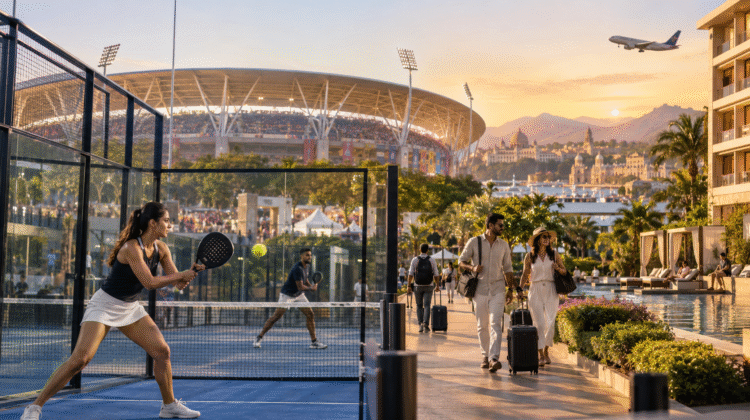
Padel is the clearest live example of what that shift looks like in practice, and the numbers behind it are genuinely startling for how recent they are. India had somewhere between 80 and 100 padel courts in 2023. By mid-2026, that number had climbed to roughly 500, with a national player base approaching 100,000 and 48 new venues opening in just the first four months of the year alone — a growth rate industry data pegs at around 70% annualised. Demand is already outpacing supply in the markets where the sport is most established: Delhi NCR and Mumbai are running 500-plus active players per court against a national average of around 305, which is the kind of pressure that turns a niche hobby into a genuine travel driver, as players start seeking out destinations and clubs rather than just the nearest court. A tournament participant needs flights, accommodation, transfers and meals; family may come along, friends may extend the trip, and what started as a two-day sporting event becomes a four- or five-day destination programme almost by accident.
Training Camps
Sporting facilities can anchor destination stays around structured practice, coaching and specialist programmes.
Amateur Tournaments
Recurring participation can turn a sporting fixture into a repeatable travel demand generator.
Wellness + Sport
Activity-led wellness programmes create a broader destination proposition than a conventional leisure break.
This shift also aligns with the wider rise of experiential travel, where destinations are increasingly competing through activities, culture and meaningful participation rather than sightseeing alone.
Sports tourism is operationally MICE
That’s really the reframe the B2B trade needs to make deliberately rather than stumble into: sports tourism is operationally MICE, not a separate category sitting next to it. A tournament needs venue management, accommodation blocks, transport, catering, sponsorship activation and delegate services — the same infrastructure a corporate conference needs, just with a different badge on the lanyard.
For hotels, that means concentrated room-night demand during periods that might otherwise sit empty. For DMCs and tour operators, it’s an opening to package pre- and post-event experiences around the competition itself. For airlines, recurring tournaments create predictable demand bursts on specific city pairs — and recurring is the operative word here, since an annual sporting calendar is a repeatable revenue stream in a way a one-off mega-event, however large, is just a spike.
Venue management, room blocks, transport, catering, sponsorship activation and delegate services are not side issues. They are the operating spine of a sports-led travel product.
That makes the opportunity part of the broader India MICE story, where venues, destination infrastructure and tier-two cities are increasingly entering the business-events conversation.
It also sits within a competitive regional picture, with global destinations competing for India’s growing MICE business and seeking differentiated products to win corporate and incentive demand.
The stadium is only the anchor
The stadium, in other words, is only the anchor. A visitor who flies in for a badminton tournament in one city or a padel championship in another should leave having also discovered the destination around it — the food, the culture, the shopping, whatever gives them a reason to come back once the tournament itself is a memory rather than a reason to travel. That’s specifically where national and state tourism boards have work to do: building sport-plus-destination itineraries in partnership with federations, hotels and DMCs, rather than marketing the event in isolation and leaving the surrounding experience to chance.
Food
Use local culinary identity to extend the sports stay beyond the competition schedule.
Culture
Build heritage, arts and local experiences into pre- and post-event programmes.
Shopping
Turn event travel into a fuller destination economy with time and spend beyond the venue.
The same logic is visible in India’s wider destination strategy: tourism growth is increasingly moving beyond established hubs, creating opportunities for India’s interior destinations to participate in new demand streams.
Tourism boards can also connect sporting calendars with the wider destination ecosystem, turning individual events into gateways for regional discovery.
Participants are different kinds of travellers
The deeper lesson sitting underneath all of this is that India’s sporting future can’t rest on producing champions alone — it has to create participants, and participants are a fundamentally different kind of traveller than spectators. Someone who discovers padel in Bengaluru, joins an archery camp in Rajasthan or combines a tournament with a wellness stay isn’t just a tourist watching something happen. They’re a repeat customer with a reason to come back on their own schedule, not just when a mega-event happens to land in their city.
“Come and play” is potentially a more durable destination proposition than “come and watch.”
That matters for planners building products around sporting communities rather than one-off event audiences. It also aligns with TheTravigator’s wider coverage of how India’s travel market is rewiring around changing demand, with experience, destination choice and product design becoming more important to trade strategy.
The stadiums are being built. The travel product has to catch up.
The stadiums are being built, at real pace — India’s padel courts alone have grown roughly fivefold in under three years. The communities are forming around them. The events, starting with a Games opening in Japan next week that India will send more than 500 athletes to, are already on the calendar. The only real question is whether the travel trade treats this as infrastructure worth building products around now, or waits until the opportunity is obvious enough that everyone else has already built around it first.
This report is part of TheTravigator’s continuing news coverage of the travel, tourism, aviation, and hospitality sectors. Our editorial team publishes industry news, market insights, partnerships, policy developments, and business updates relevant to the travel trade community. For press releases, partnership opportunities, advertising enquiries, or editorial collaborations, please contact our editorial desk at:
INFO@THETRAVIGATOR.COM