
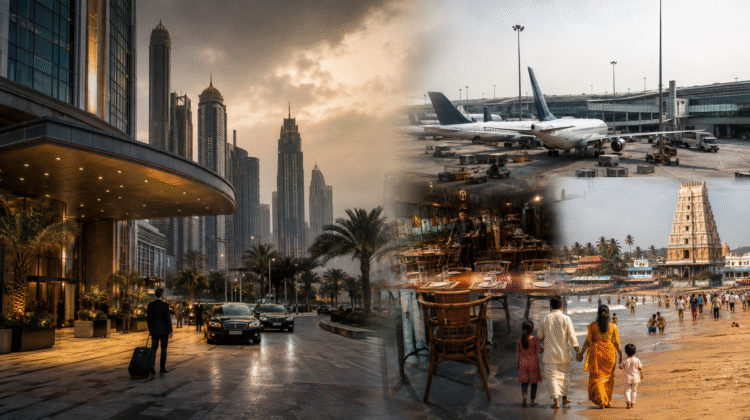
Marriott’s Q2 Numbers Reveal the Middle East Conflict’s Cost—and India Is Caught in the Crossfire
The world’s largest hotel company just put a hard number on geopolitical instability. Marriott International’s Q2 2026 earnings tell a story of global resilience overshadowed by a regional collapse—and for India, the ripple effects are measured in cancelled flights, shuttered restaurants, and a tourism sector scrambling to adapt.
The Global Picture: Strength Elsewhere, Collapse in the Middle East
Marriott delivered a solid performance across most of its portfolio. Global RevPAR rose 3.4%, with the U.S. and Canada posting a 5% gain—their strongest quarterly increase in 13 quarters. Adjusted earnings per share jumped 20% to $3.19.
But the Middle East told a different story. RevPAR in the region plunged 43% for the entire quarter—a direct financial fingerprint of the ongoing Iran conflict. The damage is so significant that Marriott now expects the Middle East to reduce full-year global RevPAR by about 100 basis points.
And the worst may be yet to come. Marriott’s CFO flagged that Q4 is the real test: the Gulf region’s peak season typically accounts for roughly 35% of the Middle East’s yearly revenue.
The India Impact: By the Numbers
While the conflict is a headwind for Marriott’s Middle East operations, India’s tourism and hospitality sector is feeling the shockwaves in equally concrete ways. A PHD Chamber of Commerce and Industry report released in April 2026 paints a granular picture of the damage:
Aviation: ₹18,000 Crore in Losses
- Indian carriers that once operated 300–350 flights daily to the Middle East are now flying just 80–90 since hostilities erupted on February 28
- Over 10,000 flights cancelled since the conflict began
- Between February 28 and March 5 alone, airlines cancelled roughly 1,770 international flights—nearly 46% of scheduled operations
- Longer routes add 2–4 hours of flying time, spiking fuel consumption and operating costs. Fuel accounts for 35–40% of airline operating costs
- Estimated net loss for the aviation industry: ₹18,000 crore
Tourism: 15–20% Drop in Inbound Traffic
- Inbound tourist traffic declined 15–20%, particularly in leisure travel, as global travellers adopt a cautious approach
- 35% of Indian outbound travellers who typically headed to the UAE and Gulf region have virtually stopped travelling there
- Overall outbound travel declined 15–20% compared to the same period last year
- Summer vacation package costs have risen 20–25% year-on-year, driven by the weak rupee (₹84 to ₹94 against the dollar) and higher airfares
Restaurants: ₹79,000 Crore Monthly Loss
- Commercial LPG supplies disrupted as government prioritises domestic cylinders—India imports roughly two-thirds of its LPG needs, with about 90% transiting through the Strait of Hormuz
- Nearly 10% of restaurants have temporarily shut down
- 60–70% have switched to induction cooking, reduced menus, or shortened hours
- Dining-out frequency fell 8–10%, average customer spend down 6–8%
- Estimated monthly loss: ₹79,000 crore to the food services industry
Hotels: A Split Story
- Metro markets like Delhi, Bengaluru, and Hyderabad saw marginal demand softening of about 10%
- Leisure destinations like Goa actually saw a 15% uptick in domestic travel
- Marriott India’s own trajectory tells the story: In March, projected double-digit RevPAR growth turned negative. By April, it shifted to marginally positive. By May, it was back to double-digit growth
The Silver Lining: Domestic Travel and New Routes
Even as global tourists stay away and outbound travel stalls, Indians are travelling more—through staycations, weddings, and pilgrimage circuits. Domestic tourism now accounts for an estimated 80–85% of India’s total tourism industry, with over 2 billion domestic trips recorded in recent years.
And this same week brought another development: Riyadh Air launched its first-ever route to India, with daily Mumbai-Riyadh flights beginning August 4, 2026. Backed by Saudi Arabia’s Public Investment Fund, the airline is positioning itself as a premium global carrier, offering onward connections through Riyadh to London, Madrid, Jeddah, and Cairo.
The timing is worth watching closely. As traditional Gulf hubs face disruption, a new carrier is betting big on India’s aviation market—one of the fastest-growing in the world.
The Bottom Line
Marriott’s Q2 earnings have finally given us a quantified picture of the Middle East conflict’s financial cost. For India, the numbers are sobering: aviation losses in the tens of thousands of crores, a tourism sector absorbing a 15–20% demand shock, and restaurants losing nearly ₹80,000 crore monthly. The sector that contributes nearly 8% to GDP and supports over 40 million jobs is navigating one of its toughest tests since the pandemic.
The real question is whether India’s domestic travel resilience, combined with new connectivity like Riyadh Air’s Mumbai route, can offset the damage. Q4 will tell the story—for Marriott, for the Gulf, and for India’s tourism-dependent economy.
This report is part of TheTravigator’s continuing news coverage of the travel, tourism, aviation, and hospitality sectors. Our editorial team publishes industry news, market insights, partnerships, policy developments, and business updates relevant to the travel trade community. For press releases, partnership opportunities, advertising enquiries, or editorial collaborations, please contact our editorial desk at:
INFO@THETRAVIGATOR.COM