Sky-High Showdown: India Joins the Global Battle for Airline Price Transparency
Sky-High Showdown: India Joins the Global Battle for Airline Price Transparency
As the US rolls back consumer protections and the EU doubles down, India’s September deadline could reshape the subcontinent’s aviation landscape—with a threat to ground non-compliant airlines.
The global aviation industry is witnessing a regulatory perfect storm. On one side of the Atlantic, the United States is quietly rolling back passenger protections. On the other, Europe is tightening its grip with the most aggressive passenger rights reforms in a generation.
And now, in a move that has sent shockwaves through Asia’s aviation corridors, India has thrown its hat into the ring with a judicial intervention that could fundamentally alter how air travel is priced across the subcontinent.
The Supreme Court’s Unprecedented Intervention
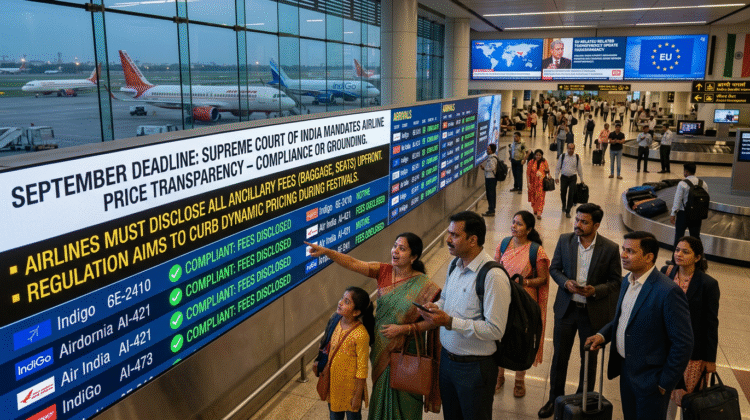
On August 17, the Supreme Court of India delivered what industry insiders are calling a “regulatory earthquake.” Hearing a public interest petition filed by social activist S. Laxminarayanan, the bench of Justices Vikram Nath and Sandeep Mehta issued a stark ultimatum to the Central Government: finalise new rules under the Bharatiya Vayuyan Adhiniyam, 2024, within seven days—or face the consequences.
The draft rules, submitted in a sealed cover by Additional Solicitor General Anil Kaushik, address the industry’s most contentious practices: dynamic pricing algorithms that cause “unpredictable fluctuations” during festivals and peak demand, ancillary charges for baggage and seat selection, and the opacity of airline pricing structures.
The industry’s next regulatory checkpoint
The Court’s next hearing is scheduled for September 7, setting a hard deadline for India’s aviation sector to prepare for what could be the most significant regulatory overhaul since the Act replaced the colonial-era Aircraft Act of 1934 on January 1, 2025.
The Court’s message was unambiguous: “If airlines are not complying, ground them”.
The petitioner, represented by Senior Advocate Ravindra Srivastava, had previously argued that airlines were exploiting a regulatory vacuum, particularly following a Civil Aviation Minister’s parliamentary statement that the government “cannot cap airfares”. The bench’s response suggests a judiciary unwilling to accept legislative paralysis on consumer protection.
The Supreme Court’s intervention, however, has not been without criticism. Legal experts and the bench itself have expressed reservations about the Act’s heavy centralisation of power. “There is a mechanism suggested but regulator, we are not sure,” the Court observed, highlighting concerns that appeals against DGCA or BCAS decisions go directly to the government, with no further appeal possible.
The Transatlantic Divergence
The Great Retreat
July 2, 2026: the US Department of Transportation finalized a rule returning airline fee disclosure standards to where they stood in 2011.
The Rights Revolution
July 13: the European Parliament approved the first overhaul of EC261 in 22 years, tightening price disclosure and passenger protections.
The Judicial Intervention
August 17: the Supreme Court intervened on airline pricing, ancillary charges and regulatory enforcement, with September 7 as the next key hearing.
United States: The Great Retreat
On July 2, 2026, the US Department of Transportation finalized a rule that returns airline fee disclosure standards to where they stood in 2011. Under this framework, airlines and ticket agents are not required to display baggage or change fees in initial fare search results. They need only note that baggage fees “may apply” and direct consumers to fine print.
This represents a significant reversal from a 2024 rule that would have required upfront disclosure of ancillary fees—a rule that was vacated by the Fifth Circuit before it ever took effect, on the grounds that the DOT had violated federal procedure. The current administration chose to abandon the rule entirely rather than redo it correctly.
Airlines for America, backed by American, Delta, United, JetBlue, and Alaska, successfully argued that the government “overstepped its authority.”
“The upfront fee disclosures Americans were promised two years ago never arrived, and it won’t arrive under the current administration”.
The regulatory retreatEuropean Union: The Rights Revolution
Across the Atlantic, the EU has moved decisively in the opposite direction. On July 13, the European Parliament approved the first overhaul of EC261—Europe’s landmark passenger rights regulation—in 22 years.
Carry-on Costs Included
Airlines, ticket agents and comparison sites must display fares including standard carry-on baggage costs from the very first search result.Claims Response
Carriers must respond to passenger claims within 30 days.Consumer Rules Expand
Carriers can no longer charge parents to sit next to their children, cancel return flights because a passenger skipped the outbound leg, or bill for correcting typographical errors in names.The reforms will cover flights departing EU airports, meaning American travellers flying home from Paris will enjoy more pricing disclosure and passenger rights than they have flying from Denver to Dallas.
What India Can Learn
The regulatory divergence offers three critical lessons for India’s aviation policymakers:
Operational Efficiency Isn’t Compromised by Protection
Research presented to the European Parliament shows that EC261 doesn’t just protect consumers—it improves operational efficiency. The regulation prevents the equivalent of 8,400 years of accumulated flight delays annually in Europe.The Cost Argument Doesn’t Hold
The total cost of EC261—including compensation, assistance, and indemnification—averages approximately €1.50 per passenger.Strong Regulators Matter
The single most powerful deterrent to anti-consumer practices is a strong, independent regulator with teeth. Rules without enforcement are merely suggestions.Europe’s same-day cancellation rate is 20% lower than in the United States, where no equivalent protection system exists.
As one consumer advocate noted, many low-cost carriers “developed their business model under the current regulation, operating without compromising their profitability”.
The Baggage Battle
When an Included Service Becomes a Revenue Stream
This mirrors a trend across global aviation, where “unbundling” has become the industry’s preferred revenue model. As the EU’s reforms demonstrate, the consumer backlash is now reaching the regulatory level.
The Aparthotel Opportunity
For B2B travel providers, this regulatory flux presents both challenges and opportunities. The aparthotel segment, represented by properties like ONE Atmosphere Suites, is particularly well-positioned to capture the growing demand for transparent, value-driven accommodation.
The Directorate General of Civil Aviation’s ongoing capacity-building efforts—including the recruitment of Airworthiness Officers and the Operational Management of Air Traffic Control Tower Construction—suggest a government committed to infrastructure modernisation, even as it grapples with regulatory frameworks.
The View From Southeast Asia
Southeast Asia Is Still Expanding
Vietnam’s emergence as Southeast Asia’s second-largest aviation market, overtaking Thailand with 7.3 million seats, underscores the region’s growth trajectory. Indonesia remains top with 11 million seats, while Vietnam’s 10% year-on-year growth outpaces Thailand’s 1.7% decline.
Vietravel Airlines’ launch of Ho Chi Minh City-Shenzhen direct flights on August 17 reflects the deepening connectivity between manufacturing hubs and Chinese markets.
What Comes Next
Three Questions Before September 7
For B2B travel professionals, the message is clear: regulatory compliance is no longer optional. As one industry observer noted, “The competition is moving from who has the best app to who has the best connectivity”. In 2026, that connectivity will increasingly mean regulatory connectivity.
India Has Entered the Global Price-Transparency Battle
India’s intervention places it squarely in the global consumer protection camp, alongside the EU. For Asia-Pacific aviation, this could be the template for a regional regulatory framework that balances market dynamics with passenger rights.
For airlines, the message is stark: prepare for a world where price opacity is no longer a viable business model.
Disclaimer: This analysis is based on publicly available information from regulatory bodies, court proceedings, and industry reports as of August 18, 2026. Regulatory developments, court decisions, and proposed legislation are subject to change.
This report is part of TheTravigator’s continuing news coverage of the travel, tourism, aviation, and hospitality sectors. Our editorial team publishes industry news, market insights, partnerships, policy developments, and business updates relevant to the travel trade community. For press releases, partnership opportunities, advertising enquiries, or editorial collaborations, please contact our editorial desk at:
INFO@THETRAVIGATOR.COM