

Airport-Based Sleep Pods: Transforming Passenger Comfort in Modern Air Travel
Air travel has become an integral part of modern life, connecting people, businesses, and cultures across the globe. In 2024, approximately 5 billion passengers flew globally, with an average aircraft occupancy of 83.6% in 2025. However, long layovers, delayed flights, and overnight connections often leave travelers exhausted and uncomfortable. A 2025 poll of 1,500 leisure travelers in the US and UK revealed that 8 in 10 travelers (80%) suffer from “sleep debt” during journeys, losing an average of 4 hours 42 minutes of sleep per trip . Nearly half (45%) attribute this sleep loss to uncomfortable airport waiting areas.
Traditional airport waiting areas, with their hard seats, bright lights, and constant noise, are rarely ideal places for rest. To address this challenge, airports around the world have introduced airport-based sleep pods a modern solution designed to provide travelers with privacy, comfort, and relaxation during their journeys.
What Are Airport Sleep Pods?
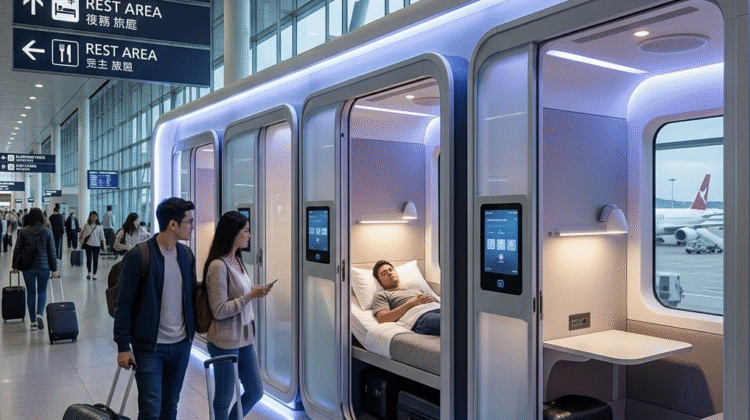
Airport sleep pods are compact, self-contained resting units located within airport terminals. These pods offer passengers a quiet and comfortable space where they can sleep, relax, or work while waiting for their flights. Equipped with modern amenities such as reclining beds, charging ports, Wi-Fi connectivity, climate control, and soundproofing, sleep pods provide a practical alternative to spending hours in crowded terminal lounges.
The concept emerged as airports sought innovative ways to improve passenger experiences. With international travel rising and long-haul flights increasing, travelers often face extended transit times between connections. The global airport sleeping pods market was valued at US$ 67.83 million in 2023 and is projected to reach US$ 144 million in 2026 , growing at a compound annual growth rate (CAGR) of 10.84% through 2032.
Key Benefits of Airport Sleep Pods
Convenience
Travelers can reserve pods for a few hours rather than committing to a full night’s stay at a hotel. This flexibility is particularly useful for business travelers, transit passengers, and those facing unexpected flight delays. Since pods are located inside or near airport terminals, passengers can rest without worrying about missing flights or navigating unfamiliar cities. Sleep pods are available at major airports like JFK (Terminals 4 and 5), Atlanta Hartsfield-Jackson, Dallas Fort-Worth (DFW), London Heathrow, London Gatwick, Amsterdam Schiphol, and Delhi’s International Airport .
Comfort
Unlike airport benches or waiting areas, sleep pods are specifically designed to promote relaxation and quality rest. Many pods feature ergonomic mattresses, adjustable lighting, and noise-reduction technology. Some premium pods include entertainment systems, personal workstations, and shower facilities. Research on thermal comfort in airport terminals shows that passengers prefer cooler temperatures than staff by 0.4–2.0°C , with neutral temperatures lying 0.6–3.9°C lower than what is typically experienced. Modern pods address this by offering personalized climate control.
Privacy
Airports are often crowded environments with constant movement and noise. In 2019, 87% of travelers expressed some degree of concern about travel safety, with privacy being a significant factor. Sleep pods offer enclosed spaces where travelers can rest without disturbances. This sense of security is especially valuable for solo travelers, women traveling alone, and business professionals carrying sensitive documents or electronic devices.
Economic and Environmental Impact
Economic Benefits
Airports generate additional revenue by renting pods on an hourly basis, creating a new income stream while enhancing customer satisfaction. Airlines also benefit indirectly, as rested passengers are more likely to have positive travel experiences and fewer complaints regarding delays. Sleep pods enable airports to diversify revenue streams and provide premium services that attract both business and leisure travelers.
Pricing varies by provider
| Provider | Average Cost | Minimum Duration |
|---|---|---|
| NapCabs | €10–15 per hour | 2 hours |
| Go Sleep Pods | $10–15 per hour | Not specified |
| Snooze Cube (single) | €18–20 + VAT per hour | Not specified |
| Snooze Cube (double) | €24–28 + VAT per hour | Not specified |
| Minute Suites | $42 per hour (+$10.50/15 min) | 1 hour |
| Hyderabad Airport (India) | ~INR 500 per hour (~$6) | Not specified |
| Delhi International Airport | ~$10 per hour | Not specified |
Environmental Sustainability
Compared to constructing large airport hotels, sleep pods require less space, fewer resources, and lower energy consumption. Their compact design allows airports to maximize available terminal space while minimizing environmental impact. Many manufacturers have incorporated energy-efficient lighting, eco-friendly materials, and smart power management systems into pod designs, further supporting sustainable airport operations.
Challenges and Considerations
Cost and Availability
While sleep pods are generally more affordable than hotels, prices can still be high at major international airports, particularly during peak travel seasons. Limited availability may lead to high demand, making reservations difficult for last-minute travelers. Airports must carefully manage pricing and capacity to ensure accessibility for a broad range of passengers.
Hygiene and Maintenance
Since sleep pods are used by multiple travelers throughout the day, maintaining cleanliness is essential. The COVID-19 pandemic emphasized the importance of health and safety standards in shared travel facilities, leading many operators to adopt enhanced cleaning measures and contactless booking systems. Rigorous cleaning protocols now include sanitization of bedding, surfaces, and ventilation systems.
Technological Innovation
Modern pods increasingly incorporate smart technologies such as mobile app reservations, automated check-in systems, biometric access controls, and personalized environmental settings. Travelers can adjust lighting, temperature, and entertainment options according to their preferences. Studies show a positive correlation between self-service technology use in airports and traveller confidence and pleasure . As technology advances, sleep pods are expected to become even more sophisticated, offering enhanced comfort and efficiency.
The Future of Airport Design
The global adoption of airport sleeping pods reflects a broader shift toward passenger-centric airport design. The market is projected to grow by USD 269.76 million at a CAGR of 10.84% by 2032 . Airports are no longer viewed merely as transportation hubs but as spaces that prioritize traveler well-being and convenience. From luxury lounges and wellness centers to sleep pods and relaxation zones, airport operators are investing in services that improve the overall travel experience.
Conclusion
Airport-based sleep pods represent a significant innovation in the aviation industry. By providing travelers with convenient, comfortable, and private spaces for rest, these facilities address many challenges associated with modern air travel—including the widespread 80% of travelers suffering sleep debt . While issues such as pricing and maintenance require ongoing attention, the benefits of sleep pods for passengers, airports, and airlines are substantial. As global travel continues to grow—with 5 billion passengers expected in 2024 —airport sleep pods are likely to play an increasingly important role in enhancing passenger comfort and transforming the airport experience.
This report is part of TheTravigator’s continuing news coverage of the travel, tourism, aviation, and hospitality sectors. Our editorial team publishes industry news, market insights, partnerships, policy developments, and business updates relevant to the travel trade community. For press releases, partnership opportunities, advertising enquiries, or editorial collaborations, please contact our editorial desk at:
INFO@THETRAVIGATOR.COM