

The Algorithmic Itinerary: Who Really Wins When Machines Plan the Journey?
The Algorithmic Itinerary: Who Really Wins When Machines Plan the Journey?
Featured image: AI-generated representative scene.
At six in the evening in a café off Jalan Hanoman in Ubud, the rain hammers the broad banana leaves outside with the sustained fury of an offshore squall. Inside, four young tech professionals from Bengaluru sit huddled around a low teak table, the glow of an iPad illuminating their tired faces. On the glass screen rests a pastel-shaded itinerary generated by an agentic travel assistant.
The document is an architectural marvel of contemporary software engineering. It displays color-coded columns, hyperlinked pins for ride-hailing waypoints, and transit times calculated to the exact minute. It had directed the four travellers to hike the Campuhan Ridge at dawn, admire a water temple thirty kilometres north by mid-morning, take a pottery masterclass in an artisan village by two, and reach a cliffside lounge in Uluwatu—eighty kilometres to the south—in time for a sunset cocktail.
“The model estimated fifty minutes between the temple and the studio,” one of them mutters, tracing a finger across the glass.
Beside the doorway, a Balinese driver in a batik shirt looks up from a cup of black kopi and smiles with gentle sympathy. “Fifty minutes? Perhaps at three in the morning when the spirits are asleep. In the afternoon, behind the gravel trucks and school vans on two-lane village roads? In this downpour, you would be lucky to reach it in three hours.”
The group had spent their entire afternoon trapped inside an idling Toyota Avanza between two flooded rice paddies, watching the clock tick past their non-refundable workshop deposit window.
Over the past twenty-four months, artificial intelligence has quietly transformed from an experimental tech curiosity into an everyday appliance of travel planning. In India, where expanding disposable incomes and a burgeoning passport-holding middle class pushed outbound departures to a record 3.27 crore in 2025, the seductive promise of the automated itinerary has found an exceptionally eager audience. Why spend thirty hours squinting at Reddit forums, sponsored listicles, and regional train timetables when a conversational prompt can assemble a seven-day European vacation in fifteen seconds?
Yet behind the glittering marketing claims of algorithmic concierges lies a profound economic friction. Travel is obstinately physical, unpredictable, and governed by local geography and human inertia. Generative algorithms, by contrast, are statistical prediction engines trained on historical digital text. When mathematical optimization collides with a flooded provincial road, an unseasonal rail strike, or a family’s varying walking pace, the friction does not simply evaporate. It transfers directly onto the traveller’s balance sheet.
From discovery to execution
To understand how Indian travellers are engaging with artificial intelligence, one must look past the breathless Silicon Valley narrative of fully autonomous bots managing vacations end-to-end without human intervention. That world remains largely theoretical. On the ground, adoption has organized itself into three distinct operational layers.
The first and most widespread layer is top-of-funnel discovery. Here, conversational models like Perplexity, ChatGPT, and Google Gemini have decimated traditional search queries and affiliate-driven travel blogs. For urbane professionals in Mumbai, Delhi, or Bengaluru, conversational engines deliver immediate consumer surplus, compressing dozens of hours of manual research into a single afternoon session: “Draft a six-day itinerary through Andalusia utilizing regional rail, avoiding cruise ship ports, with boutique hotels under €180 a night.”
More significantly, this discovery layer has democratized international travel for first-time outbound holidaymakers from tier-2 and tier-3 industrial hubs—cities like Surat, Coimbatore, and Indore. For these travellers, the primary barrier to cross-border journeys has never been money alone, but the sheer intimidation of navigating foreign airport transfers, baggage rules, and visa protocols. Conversational bots operating over mobile messaging apps act as patient, multilingual translators, deconstructing complex transit regulations into conversational Gujarati, Tamil, or Hindi.
Deeper down the transaction funnel, the nature of the software changes. Major domestic online travel platforms, including MakeMyTrip, EaseMyTrip, and Agoda, have deployed generative interfaces primarily as dynamic pricing filters and defensive customer-service barriers. These tools ingest messy customer inputs, suggest alternative departure dates, and deflect routine inquiries away from expensive human call centers.
The true operational frontier, however, belongs to the transactional concierges attempting to link discovery directly with execution. In September 2026, at the Global Fintech Fest in Mumbai, the Indian travel media platform Travelxp unveiled Marco, an agentic travel assistant designed to operate across WhatsApp, Instagram, and web portals. Marco was built not merely to suggest sights, but to act as an agentic payment and live-rate query engine: querying live airfares and room rates across booking channels, executing bookings directly within pre-set user budgets, and demanding explicit biometric authorization the moment choices breach financial thresholds.
Meanwhile, venture-backed startups are targeting high-value demographic niches. On July 21, 2026, Gurugram-based travel-tech platform 30 Sundays announced a ₹61 crore ($6.7 million) Series A funding round led by Bessemer Venture Partners, alongside Info Edge Ventures and Eximius. Rather than peddling rigid, mass-market package tours, 30 Sundays deploys generative models to automate customer intake, draft highly visual sample itineraries, and power an on-trip digital concierge that coordinates restaurant reservations and activity changes for couples and honeymooners, with planned expansion into family holidays.
The venture capital flowing into this space is notably discerning. Investors have largely abandoned basic API wrappers that merely pass user prompts to third-party language models. Sustainable enterprise value in travel economics does not belong to prompt engineers; it accrues to platforms that own the underlying transaction rails—direct New Distribution Capability (NDC) feeds from airlines, robust API pipelines into hotel inventory aggregators, and ground networks capable of handling payment reconciliations and cancellations when something goes wrong.
The human chemistry of travel
Yet the true test of algorithmic travel lies not in its software architecture, but in its human chemistry. The efficiency of automated planning varies wildly depending on whether one travels alone, as a couple, or with an extended family.
The solitary traveller experiences artificial intelligence first as an immense relief from cognitive overhead. Moving through a foreign country alone requires evaluating neighborhood safety, bus connections, and accommodation logistics without a partner to share the diligence. An algorithmic assistant can instantly map out an overland route from Da Nang to Luang Prabang, estimating local bus fares and pedestrian walking distances in seconds.
Yet this frictionless efficiency introduces an insidious economic externality: algorithmic conformity.
Large language models do not discover the world; they synthesize existing digital corpora. Because their training sets are dominated by commercial booking reviews, travel blogs, and search-optimized listicles, their recommendations regress inexorably toward the historical mean. When thousands of solo backpackers ask an algorithm for an “authentic, off-the-beaten-path cultural walk in Kyoto,” the engine does not direct them to an unindexed carpenter's shop in an outer residential ward. It routes them to the exact same five shrines and tea houses that have populated top-ten listicles for the past decade. The result is an algorithmic echo chamber, where hundreds of independent travellers seeking solitude find themselves funneled into the identical riverside café in George Town or the same cliffside viewpoint in Madeira, clutching itineraries generated by the identical set of statistical weights.
Worse still, the algorithm's utility collapses when physical safety is introduced. This skepticism is especially acute among Indian solo female travellers. An automated guide might blithely describe a district in Naples or Athens as “bustling and centrally located,” entirely blind to flickering streetlights, deserted dead ends, or recurring evening harassment outside a specific metro station. For safety verification, solo travellers systematically abandon AI in favor of analog human intelligence: hostel bulletin boards, private WhatsApp safety circles, female-travel Reddit forums, and conversations with front-desk clerks. Real-world safety remains stubbornly resistant to algorithmic synthesis.
The economics of travelling together
Where the solitary traveller bargains only with their own appetite for risk, two people travelling together introduce the delicate arithmetic of joint utility. In economic terms, planning a couples' vacation resembles a two-player cooperative game with imperfect information. One partner may seek restful mornings, boutique design, and slow lunches; the other demands early starts, museums, and high-tempo sightseeing. Reconciling these divergent preferences through manual research frequently generates acute decision fatigue and interpersonal tension.
Shared digital planning tools alter this dynamic by serving as an objective, neutral arbiter. By feeding conflicting preferences into a structured prompt, couples effectively offload the emotional cost of compromise onto the machine. The algorithm delivers a balanced schedule without taking sides.
Yet in the premium romantic travel sector, automation runs into an emotional wall. For companies like 30 Sundays, algorithmic intake tools dramatically compress initial design turnaround, allowing travel designers to handle higher client volumes. But romance is an extraordinarily high-stakes emotional purchase. A delayed museum transfer during an executive business trip is an annoyance; a construction crane blocking the sunset view of an overwater bungalow during a ₹5,00,000 honeymoon in the Maldives is an emotional catastrophe.
Consequently, couples exhibit a remarkably high willingness to pay for a human travel consultant at the final confirmation gate. They welcome AI for rapid visual curation, but they demand an experienced human professional to guarantee that a private boat charter is genuinely private, that hotel management has received their anniversary note, and that a living person can be reached on the phone if tropical weather cancels an inter-island seaplane transfer.

Where group logistics defeat the algorithm
The moment you add three generations of family members, however, the neat logic of the algorithm breaks down entirely.
The group trip—whether an extended Indian joint family holiday spanning toddlers, working parents, and elderly grandparents, or an annual reunion of college friends—is an immensely complex logistical endeavor that exposes three structural failures of language models:
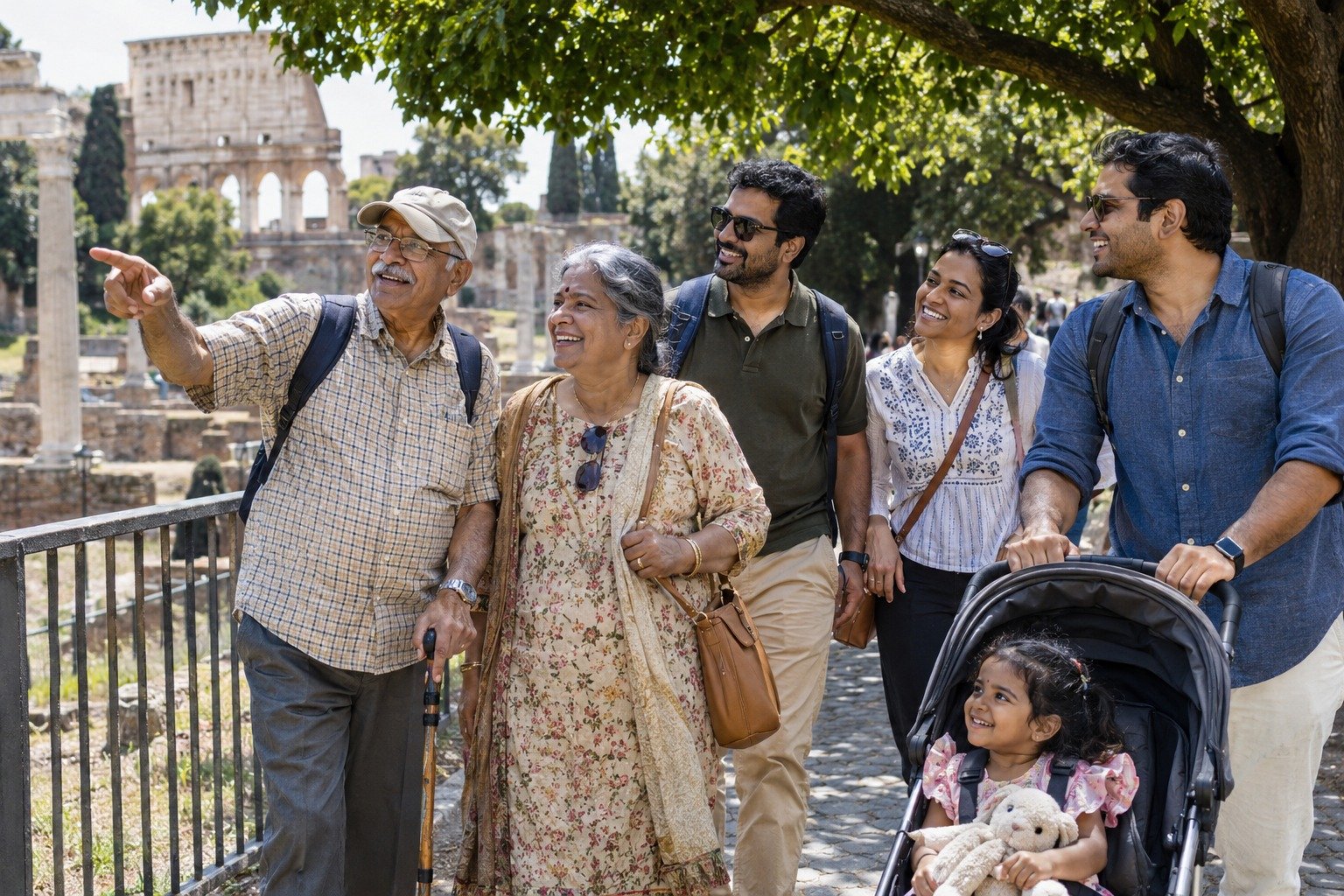
The first is the heterogeneous pace problem. Algorithms calculate time linearly. A model will happily inform you that walking from the Colosseum to the Roman Forum takes twelve minutes. That holds true for a solitary twenty-six-year-old in running shoes. For an eight-member family including grandparents with arthritic knees, a child in a stroller, and relatives pausing for water, that same walk takes forty-five minutes. When an automated schedule packs four tightly timed attractions into a single afternoon, the entire day collapses by lunchtime under a wave of exhaustion and frustration.
The second is the inventory bottleneck. Group travel requires coordinated contiguous room blocks, specific dietary accommodations—such as vegetarian or strict Jain meals—and split-payment settlements across multiple family bank accounts. An algorithm can generate a beautiful itinerary table, but it cannot negotiate a group booking discount, hold ten seats at a uniform airline fare class, or resolve UPI payment failures between family members across different Indian cities.
The third and fatal flaw is the absence of liability. When an automated schedule books an outdoor mountain trek during an unseasonal local monsoon alert, leading to stranded travellers and forfeited non-refundable deposits, the algorithm assumes zero responsibility. The terms of service of the model provider explicitly disclaim all commercial and physical liability. Within an extended family, the cousin or uncle who entered the prompt becomes the target of collective blame. To avoid this social risk, group travellers consistently retreat to traditional tour operators and Destination Management Companies (DMCs) who shoulder operational liability and provide on-ground rescue when plans disintegrate.
The outbound travel ledger
When scaled across millions of outbound travellers, these micro-level planning choices accumulate into macro-level economic realities.
Consider the ledger of India’s international travel balance. Under the Reserve Bank of India’s Liberalised Remittance Scheme (LRS), outward remittances for overseas travel stood at $17.00 billion in FY24, accounting for 53.56 percent of total LRS remittances of $31.74 billion. In FY25, travel spending held steady at $16.96 billion, even as its share of total LRS remittances rose to 57.37 percent against a moderated overall outflow of $29.56 billion. By FY26, total LRS remittances cooled further to approximately $28.98 billion, with travel outlays settling between $16.4 billion and $16.87 billion. Early indicators from April and May of FY27 suggest that travel remittances have contracted another 8 percent year-on-year.
At first glance, this softening in dollar spending appears contradictory. After all, Ministry of Tourism data indicates that outbound departures by Indian nationals rose 5.9 percent in 2025 to 3.27 crore, up from 3.09 crore in 2024. How can passenger volumes reach all-time highs while central bank foreign exchange remittances contract?
The answer lies precisely in the behavioral shift enabled by low-cost travel tools and changing regional preferences. Faced with currency depreciation against the US dollar, elevated airfares on long-haul routes, and geopolitical detours around West Asia, Indian holidaymakers have not stopped travelling; they have substituted long, high-spend European or North American holidays for shorter, budget-conscious trips to Southeast Asia and Central Asia. Travellers are taking four-day weekend breaks to Bangkok, Kuala Lumpur, Baku, or Almaty instead of two-week tours through Switzerland.
At the same time, India’s inbound tourism ledger presents a sobering counterweight. In 2025, Foreign Tourist Arrivals (FTAs) to India contracted 9.4 percent to 90.2 lakh, down from 99.5 lakh in 2024. This widened the apparent tourism deficit between foreign tourist arrivals and outbound Indian departures to an eye-watering ratio of 1:3.6.
Yet an economist must dissect this aggregate figure with care. The steep drop in 2025 arrivals was not caused by a collapse in global interest; it was driven almost entirely by a catastrophic 73 percent decline in arrivals from Bangladesh following violent political upheavals in Dhaka. Because Bangladeshi visitors historically account for 17 to 18 percent of all foreign tourist arrivals to India—frequently crossing land borders for medical care, trade, and visiting relatives—the disruption distorted the headline numbers. Stripping out Bangladesh, arrivals from the rest of the world actually grew by 4.25 percent in 2025, with inbound leisure and business travel from the United States, the United Kingdom, Australia, and Canada maintaining modest growth.
Furthermore, the statutory definition of Foreign Tourist Arrivals counts only foreign passport holders, explicitly excluding Non-Resident Indians (NRIs). Total International Tourist Arrivals (ITAs), which encompass diaspora visitors holding foreign residency, reached roughly 20.1 million in 2025 and 20.6 million in 2024. The diaspora component—roughly ten to eleven million annual arrivals—injects substantial foreign currency directly into the domestic hospitality and retail economy, moderating the structural imbalance.
Nonetheless, generative AI functions as a profound accelerator of this outbound exodus. By eliminating search frictions, demystifying foreign transit, and generating bespoke itineraries in seconds, digital tools lower the psychological barrier to crossing borders. An Indian urban household with a discretionary holiday budget of ₹2,50,000 once defaulted to Kerala, Rajasthan, or Himachal Pradesh out of sheer familiarity. Today, an algorithmic prompt demonstrates that the same sum covers round-trip airfare, boutique villas, and dining in Vietnam, Georgia, or Sri Lanka, directly siphoning domestic discretionary expenditure into foreign economies.
For the host destinations, however, algorithmic optimization carries a hidden sting: hyper-concentration. Because language models synthesize the same high-ranking web corpus, they channel thousands of international travellers into the exact same geographical pockets. In Bali, footfall concentrates relentlessly along the narrow coastal corridors of Canggu, Seminyak, and Ubud, overwhelming local drainage and road infrastructure, while the cultural regencies of the north and east remain starved of visitor revenue. In Thailand, algorithmic recommendations herd tourists into identical beachfronts in Phuket and Pattaya. While national tourism ministries boast of record visitor numbers, municipal authorities find themselves spending millions managing municipal waste, traffic paralysis, and resident resentment.
Consent, liability and trust
Beyond physical traffic and macroeconomic balances lies an impending institutional hurdle: legal liability and data privacy.
The business model of algorithmic travel relies upon extensive data ingestion. To generate a truly tailored itinerary, a digital concierge requires intimate personal data: dietary restrictions, medical conditions, passport numbers, children’s ages, real-time geolocation, and linked financial accounts. In the experimental rush of recent years, travel tech platforms routinely scraped and stored this data with minimal governance.
That era is closing. Under India’s Digital Personal Data Protection (DPDP) Act of 2023, the regulatory architecture has moved from theoretical statute to binding administrative enforcement. Following the formal notification of the DPDP Rules on November 13, 2025, the statutory consent-manager architecture becomes operational on November 13, 2026, culminating in full substantive enforcement on May 13, 2027.
The statute introduces severe financial penalties structured along graduated compliance tiers: up to ₹250 crore for failing to implement reasonable security safeguards to prevent personal data breaches under Section 8(5); up to ₹200 crore for failing to report a personal data breach to the Data Protection Board and affected users under Section 8(6); and up to ₹200 crore for breaching statutory protections regarding children's personal data under Section 9.
For travel tech startups and established agencies, these penalties represent existential business risks. If an agentic travel bot suffers a security exploit that leaks thousands of customer passport scans, hotel room assignments, and payment tokens, or processes tracking data on traveling minors without verified parental consent, the resulting regulatory fines would wipe out years of venture capital. Over the coming eighteen months, the travel technology industry will be forced to undergo an expensive architectural overhaul, pivoting away from freewheeling data scraping toward zero-knowledge processing, local device storage, and verified consent management.
This regulatory reality aligns with a broader consumer paradox. A comprehensive study by international travel insurer IMG revealed that while 75 percent of surveyed travellers actively use artificial intelligence tools to research destinations and generate recommendations, a mere 13 percent trust these automated systems to execute the final transaction.
That staggering 62-point gap between research and booking is the defining boundary of the digital travel economy. Travellers are delighted to let an algorithm do the heavy lifting of gathering, sorting, and summarizing options. But when real money, family safety, and non-refundable deposits are on the line, human beings instinctively seek human verification.
The value of human judgement
Back in the Ubud café, the rain gradually slows to a warm, fragrant mist drifting over the terraced rice paddies. The four Bengaluru tech professionals finish their ginger teas, fold up their digital tablet, and hail the driver in the batik shirt waiting by the doorway.
They agree to pay him a fair day rate in cash to take over their schedule: to guide them down back roads only locals know, to call ahead to a warung where his cousin prepares fresh duck, and to steer them away from the flooded ravines.
Artificial intelligence has made the world remarkably easy to imagine. But travel is not an intellectual exercise in statistical prediction; it is an unpredictable, sensory encounter with physical reality. And in the final reckoning, the most valuable luxury in modern travel is not a faster algorithm, but the quiet reassurance of an experienced human being who knows what happens when the road washes out.