
Travel in Troubled Times: How Geopolitical Fractures are Redrawing the World’s Flight Paths
Travel in Troubled Times: How Geopolitical Fractures are Redrawing the World’s Flight Paths
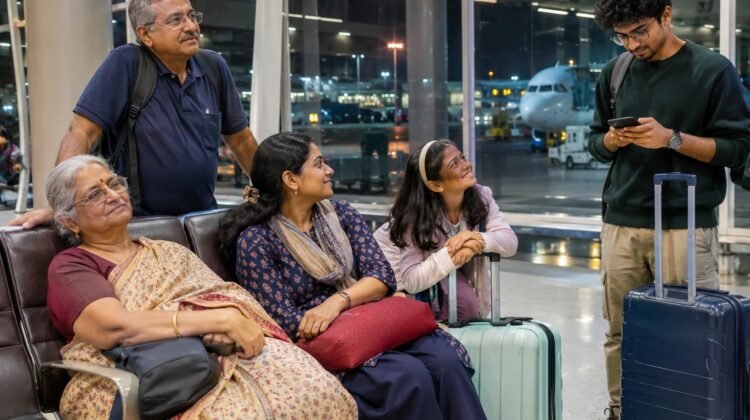
Featured image: AI-generated representative scene.
At three in the morning inside Terminal 3 of Dubai International Airport, the dazzling illumination of luxury duty-free storefronts reflects off hundreds of travellers sleeping fitfully across concourse benches and carpeted terminal floors.
Clustered near Gate B22, thirty-two members of an extended family tour group from Hubballi, Karnataka, have formed an encampment around a perimeter of wheeled suitcases. Two grandmothers in silk sarees rest against soft carry-on bags; a young software engineer holds a conference call with relatives in Bengaluru, while the family elder debates quietly with an airline representative wearing a high-visibility transit badge.
The group had been returning from a two-week European tour. While their wide-body aircraft was cruising above the Arabian desert, an emergency airspace closure following missile exchanges across West Asia forced regional air traffic controllers to issue immediate diversions. The aircraft was rerouted to Dubai. Within an hour, their connecting flight to Mumbai was frozen as airspace corridors jammed and regional departure slots were cancelled.
By daybreak, the family’s international debit cards were bouncing against daily overseas spending limits. Nearby transit hotels, inundated by thousands of passengers dumped from diverted transcontinental flights, saw spot room rates surge from off-peak levels of ₹7,000 to over ₹22,000 per night.
“Our travel agent back in Karnataka insists the airline must house us,” the younger engineer says, gesturing toward his phone screen. “The airline counter points to the force majeure clause printed in the fare rules, disclaiming liability for sovereign military events. We are sitting in one of the richest terminals in the world with limited cash, expired phone data packs, and no idea when the sky will reopen.”
This nocturnal scene encapsulates the defining structural reality of modern travel economics.
For nearly thirty years, the globalization of leisure travel rested on the seductive fiction that air corridors were boundless and friction-free. Global aviation constructed its greatest logistical triumphs around Persian Gulf mega-hubs—Dubai, Doha, Abu Dhabi—designed as immaculate switching stations linking South Asia with Europe, Africa, and the Americas. India’s ascending middle class, armed with rising incomes and eager for international experience, became the lifeblood of these aerial transit highways.
Today, that architecture is buckling under geopolitical stress. Instability is no longer confined to active conflict zones on the ground; it translates into contagious infrastructure disruption in the air. Even when a traveller’s origin and destination are completely secure, the invisible aerial highways connecting them can shatter in an hour, triggering closed flight information regions, mandatory fuel detours, grounded fleets, and acute passenger liquidity crises.
Physical danger and network disruption
To analyze the economic consequences of this instability, one must first distinguish between localized physical danger and systemic infrastructure disruption.
Physical danger is geographic, acute, and contained. When military strikes target a specific territory—whether in Tel Aviv, Beirut, or border borderlands—commercial tourism to that destination halts immediately. Direct flights are suspended, travel insurance coverage is invalidated, and tour operators evacuate staff. The economic loss is severe, but it is bounded by territory.
Infrastructure disruption, by contrast, is networked, regional, and highly contagious.
A military flare-up in West Asia does not merely halt flights to the combatants; it forces the entire international civil aviation network into an emergency spatial reallocation. In the spring of 2026, heightened military exchanges involving Iran and regional powers triggered sudden closures across Iranian, Iraqi, and Gulf airspaces. This choked off the primary East-West air corridor that connects South Asia to Europe and the Western Hemisphere.
The financial transmission of this aerial shock was recorded clearly in central bank data. According to the Reserve Bank of India (RBI), outward remittances for overseas travel under the Liberalised Remittance Scheme (LRS) plummeted by 16 percent month-on-month in March 2026. Yet on a year-on-year basis, March travel remittances dipped by just 2.75 percent.
This statistical divergence illustrates the precise nature of modern geopolitical friction: sudden airspace closures do not destroy consumer demand; they trigger sharp, involuntary operational postponements. Flights are cancelled, travel dates are deferred, and transaction capital freezes in corporate suspense accounts until corridors reopen.
When central air corridors are severed, flights departing from Delhi, Mumbai, or Bengaluru cannot fly standard great-circle routes. Instead, they must navigate narrow bypass bottlenecks—either detouring south across the Arabian Sea and the Red Sea corridor or sweeping north through Central Asia and the Caucasus.
The price of closed airspace
This regional vulnerability is acutely exacerbated by a chronic bilateral impasse closer to home: the comprehensive closure of Pakistan’s airspace to Indian carriers.
While airspace was temporarily opened following earlier crises, the Pakistan Airports Authority (PAA) instituted a new comprehensive airspace ban on Indian-registered commercial carriers on April 23, 2025, an embargo formally extended through November 24, 2026. In an immediate reciprocal move, India closed its own airspace to Pakistani carriers on April 30, 2025.
The operational penalty of this restriction on westbound Indian flights is brutal. Long-haul flights operated by Air India and IndiGo from northern Indian hubs cannot head directly west across Punjab and Sindh. Instead, they must bank sharply south toward Gujarat, loop over the Arabian Sea, and cross into the Persian Gulf.
Aviation operational data indicates that this mandatory diversion adds seventy-five to one hundred and twenty minutes to westbound flight times to Europe and North America. It forces an estimated 15 to 20 percent increase in aviation turbine fuel (ATF) burn per sector, while imposing punishing payload restrictions that force airlines to sacrifice commercial cargo capacity or leave passenger seats empty to carry statutory reserve fuel.
The financial cost of these detours is borne directly by airline balance sheets. When Air India posted a record $2.8 billion annual loss, management pointed to airspace closure detours, inflated fuel burn, and complex crew scheduling logistics as severe contributing drivers. In modern civil aviation, geography cannot be negotiated; every extra minute in the air consumes capital.
How travellers price uncertainty
As geopolitical disruption transforms the geography of flight, it reconfigures the behavioral economics of different traveller cohorts.
The solitary traveller absorbs geopolitical volatility through a heightened perception of personal vulnerability. Traveling without a companion or an institutional sponsor, the solo adventurer cannot afford to be stranded in a transit hub with depleted funds or ambiguous consular support.
Consequently, solo travel has seen a defensive pivot in financial planning. Independent travellers have largely abandoned basic medical travel policies in favor of comprehensive insurance packages featuring explicit clauses for emergency geopolitical evacuation, trip interruption, and airspace stranding cover. At the same time, solo travellers increasingly rely on real-time open-source intelligence—monitoring flight tracking portals like Flightradar24, consular social media feeds, and regional aviation forums—to assess operational risks before arriving at the boarding gate.
For couples, geopolitical uncertainty strikes directly at the economics of destination substitution and luxury celebration.
Over the past decade, the Indian luxury outbound wedding and anniversary market evolved into a multi-billion-dollar enterprise, with high-net-worth couples funneling an estimated ₹15,000 crore annually into lavish celebrations across Turkey, the United Arab Emirates, Oman, and Southeast Asia.
When regional air corridors fracture, however, the logistical risk of flying two hundred guests through volatile transit hubs becomes unmanageable. If a single airspace closure strands the wedding party in Dubai or Doha, a multi-day celebration collapses into chaos.
In response, wealthy couples have executed a decisive domestic retreat. The capital once earmarked for destination celebrations in Antalya or Ras Al Khaimah is flowing back into domestic palatial venues in Udaipur, Jodhpur, and Goa. In the leisure sector, couples are substituting complex multi-leg European holidays with non-stop direct flights to stable regional havens like Sri Lanka, Vietnam, or Mauritius, willingly sacrificing long-haul prestige for transit certainty.
The group liquidity trap
For extended family groups and corporate contingents, geopolitical shocks create acute liquidity traps.
When an extended family of twenty or a corporate MICE group of fifty faces an unexpected flight cancellation due to airspace closure, the financial damage is immediate. Large group bookings are typically secured through rigid, non-refundable commercial contracts. When airlines invoke force majeure, they rarely issue immediate cash refunds; instead, they offer rebooking credits, travel vouchers, or future ticket shells.
For a middle-class family that pooled savings to fund a dream overseas reunion, receiving ₹10,00,000 in non-refundable airline vouchers is catastrophic. The money remains locked in an airline database, while the family must immediately find liquid cash to fund emergency transit accommodation, local meals, and alternate transportation. The group is left bearing the financial risk of sovereign conflict.

Reading India’s tourism ledger
These micro-level shocks interact with India’s broader macroeconomic ledger in unexpected ways.
In 2025, India’s tourism statistics recorded an apparent anomaly. Outbound departures by Indian citizens expanded 5.9 percent to reach an all-time record of 3.27 crore, up from 3.09 crore in 2024. Yet across the same period, Foreign Tourist Arrivals (FTAs) to India fell 9.4 percent to 90.2 lakh, down from 99.5 lakh in 2024. On paper, this widened India’s tourism deficit to a dramatic ratio of 1:3.6.
Yet an economist must dissect this inbound contraction with analytical precision. The 9.4 percent decline was not caused by a collapse in global Western tourist appetite; it was almost entirely the result of a sudden 73 percent collapse in arrivals from Bangladesh following violent political upheavals, regime changes, and subsequent border restrictions in Dhaka.
Because Bangladeshi visitors historically represent 17 to 18 percent of all foreign tourist arrivals to India—crossing land borders for medical treatment, textile trade, and family visits—the political crisis in Dhaka distorted the aggregate national data. When Bangladesh is excluded from the calculation, inbound tourist arrivals from the rest of the world actually expanded by 4.25 percent in 2025, with leisure and business arrivals from the United States, the United Kingdom, Australia, and Canada maintaining steady growth despite regional airspace detours.
Furthermore, official FTA statistics measure only foreign passport holders, omitting the vital contribution of Non-Resident Indians (NRIs). Total International Tourist Arrivals (ITAs), which encompass diaspora visitors, reached roughly 20.1 million in 2025 and 20.6 million in 2024. The diaspora component—amounting to ten to eleven million annual entries—provides a massive, stable influx of foreign exchange that cushions the domestic hospitality sector from geopolitical volatility.
The durability of international travel in the face of political strain is vividly demonstrated by India’s bilateral relationship with Canada. Between late 2023 and 2024, severe diplomatic tensions erupted over extraterritorial allegations, leading to consular expulsions and visa freezes. Yet by 2025, pragmatic economic self-interest and diaspora realities asserted themselves: diplomatic channels normalized, standard visa processing resumed, and air traffic between Toronto, Vancouver, and Delhi stabilized. Commercial and familial ties proved far more resilient than temporary diplomatic rhetoric.
The domestic substitution mirage
Yet within India’s domestic travel industry, a dangerous macroeconomic fallacy has taken hold: the domestic substitution mirage.
When geopolitical tensions deter Indian families from holidaying in Europe or the Middle East, domestic hotel chains and state tourism boards celebrate. Discretionary spending shifts to luxury resorts in Kashmir, the Andaman Islands, Kerala, and Rajasthan. Industry spokespersons declare that outbound capital has been successfully captured at home.
To an economist, however, this substitution is an illusion. When an Indian citizen spends ₹3,00,000 at a heritage hotel in Udaipur instead of a hotel in Vienna, rupees are merely circulating within the domestic banking system. But when a foreign tourist cancels a trip to India due to perceived regional instability or inflated airfares, India permanently forfeits scarce foreign currency earnings. Domestic travel substitution can sustain local hotel occupancy, but it cannot replenish the national balance of payments. In an era of elevated global fuel costs, foreign exchange earned from inbound international tourism remains irreplaceable.
The invisible geopolitical tax
As the first rays of morning sun break through the glass facades of Terminal 3 in Dubai, an announcement chimes over the public address system. The family from Hubballi stirs as an updated departure gate flashes green on the flight information display. Their flight to Mumbai has been rescheduled; an alternate air corridor through southern airspace has been cleared.
The family gathers their baggage, checks their boarding passes, and forms a line at the gate. They are exhausted, financially depleted by emergency expenses, and weary of airline fine print, but they are going home.
Their experience confirms an enduring truth of modern transport economics: travel will not cease because the world is unstable. Human curiosity, commercial necessity, and diaspora bonds are among the most persistent forces in the global economy.
Yet the era of effortless, unthinking international mobility is over. The open skies of the post-Cold War era have been partitioned into sovereign choke points, military exclusion zones, and contested corridors. Travel has become an exercise in risk pricing, where the true cost of an overseas ticket includes an invisible geopolitical tax—paid in longer flight times, costlier insurance premiums, and the ever-present threat of a middle-of-the-night diversion. The modern traveller may still cross the world, but they must now pack an economist’s understanding of the fragile, fractured skies above them.