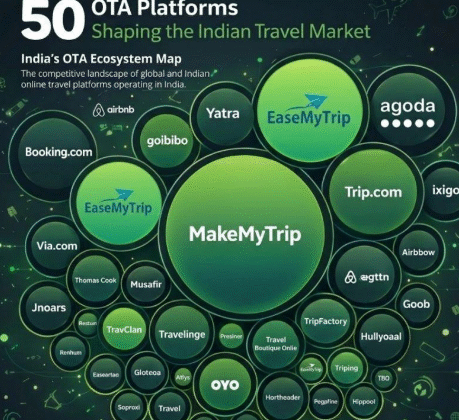
OTA Consolidation Accelerates as India’s Travel Ecosystem Moves Towards Connected Distribution
India’s online travel market is increasingly moving beyond the traditional OTA model of simply aggregating flights and hotel rooms. Recent acquisitions and partnerships involving MakeMyTrip, ixigo, Air India, Booking.com and IndiGo show how travel companies are expanding across supply, experiences, accommodation, loyalty and distribution.
The emerging model is less about owning a single booking point and more about controlling or connecting multiple parts of the traveller journey.
MakeMyTrip Moves Deeper Into Organised Experiences
MakeMyTrip’s acquisition of a majority stake in Flamingo Transworld is one of the clearest examples of an OTA moving deeper into packaged and experiential travel.
MakeMyTrip announced the agreement in March 2026 and subsequently completed the majority investment on 9 March 2026. Flamingo, which has operated for more than three decades, has a strong presence across Gujarat, Maharashtra, Rajasthan and Madhya Pradesh, with curated group tours serving domestic and international travellers.
The acquisition gives MakeMyTrip greater exposure to an area that is difficult to build through pure digital aggregation: locally curated travel products and operational expertise.
Flamingo’s proposition includes regional-language tour managers, Indian and Jain/vegetarian meal arrangements and curated attractions and experiences. MakeMyTrip has said the combination is intended to broaden its holiday-package offering and expand Flamingo’s reach through its digital platform and national customer base.
The move is therefore significant not simply because an OTA has acquired a tour operator, but because it connects digital demand with offline destination execution.
ixigo Targets the Flexible-Stay Accommodation Gap
ixigo is pursuing a different route into supply.
In June 2026, Le Travenues Technology, which operates ixigo, announced the acquisition of a 54.66% stake in Brevistay Hospitality for ₹65.69 crore. Brevistay specialises in flexible-duration hotel bookings, including short stays and overnight accommodation.
The companies’ combined hotel network was reported at more than 10,000 directly contracted hotels across India. ixigo said the transaction would help expand accommodation choices across leisure, business, transit and short-stay use cases, while strengthening hotel contracting and direct inventory.
That is strategically different from simply adding more hotel listings.
Flexible accommodation addresses use cases such as transit passengers, business travellers, last-minute stays and travellers requiring rooms for shorter periods. Brevistay’s existing supply relationships therefore give ixigo access to a specialised segment of accommodation demand.
The transaction also fits ixigo’s broader technology strategy, with the company highlighting AI, customer insights and its distribution platform as tools for improving discovery and conversion.
Air India Brings Accommodation Into the Airline Booking Journey
The movement towards connected travel is not restricted to OTAs.
In June 2026, Air India and Booking.com announced a strategic partnership allowing Air India customers to access accommodation through a dedicated co-branded platform on the airline’s website and mobile application.
The Booking.com-powered platform gives Air India customers access to more than 31 million reported accommodation listings, including homes, villas and other alternative accommodation, with exclusive benefits and loyalty rewards for Maharaja Club members.
The significance is straightforward: an airline traditionally responsible for selling the flight is increasingly participating in the accommodation component of the same journey.
Air India’s wider digital strategy reinforces this direction. Its redesigned mobile app brings together booking, payments, airport services, disruption support, baggage tracking, loyalty management and AI-powered assistance in a single platform.
The airline is therefore building a broader digital travel interface rather than restricting its digital relationship with customers to air tickets.
IndiGo Connects Flights and Hotels Through Loyalty
IndiGo is taking another approach by connecting aviation and hospitality through loyalty.
In July 2026, IndiGo BluChip and ALL Accor announced a reciprocal loyalty partnership allowing members to convert points between the two programmes. IndiGo customers can convert BluChips into ALL Accor Reward Points, while Accor members can convert eligible points into IndiGo BluChips.
The partnership links IndiGo’s airline network with Accor’s hospitality ecosystem covering more than 45 brands and thousands of destinations worldwide.
The commercial logic is different from an acquisition, but the underlying direction is similar: the boundaries between air travel, accommodation and customer loyalty are becoming less distinct.
A traveller can now earn through one part of the journey and use those rewards in another.
From Inventory Aggregation to Ecosystem Control
Taken together, these developments point to a changing structure for India’s travel-distribution market.
| Company / partnership | Strategic move | Connected layer |
|---|---|---|
| MakeMyTrip + Flamingo | Majority acquisition | Tour packages & experiences |
| ixigo + Brevistay | Majority acquisition | Flexible accommodation |
| Air India + Booking.com | Co-branded accommodation platform | Flights + hotels |
| IndiGo + ALL Accor | Reciprocal loyalty | Flights + hotels + rewards |
The models are different, but each reduces the distance between previously separate parts of the travel journey.
For MakeMyTrip, the integration is between digital distribution and organised tours.
For ixigo, it is between its customer base and specialised hotel inventory.
For Air India, it is between airline bookings and accommodation discovery.
For IndiGo and Accor, it is between aviation and hospitality loyalty.
Why Direct Supply Is Becoming More Important
For travel platforms, access to inventory alone is no longer necessarily sufficient.
Large OTAs can already aggregate enormous volumes of flights and hotel rooms. Differentiation increasingly comes from exclusive supply, specialised products, better customer data, direct contracting and control over the booking journey.
MakeMyTrip’s own corporate disclosures describe its strategy as building a technology-led ecosystem integrating demand, supply and servicing layers across hotels, alternative accommodation, packages, tours, attractions and other travel services.
ixigo’s Brevistay transaction similarly expands its directly contracted hotel supply while giving it access to a specialised flexible-stay network.
This represents a shift from the classic OTA proposition:
Search → Compare → Book
towards a broader model:
Discover → Personalise → Package → Book → Stay → Earn → Re-engage
The more stages a platform participates in, the more opportunities it has to retain the customer relationship.
The Rise of the Connected Trip
The broader travel industry is already moving in this direction.
Booking.com’s technology infrastructure, for example, supports integrations that can allow third-party platforms to display travel content, search live inventory, compare availability and, depending on the integration, complete bookings without redirecting customers away from the partner platform.
This means the future of travel distribution does not necessarily require every company to own every component.
Instead, companies can connect ecosystems through APIs, partnerships, loyalty programmes, acquisitions and embedded booking experiences.
That distinction is important for India’s travel industry.
The winning architecture may not be a single super-platform that owns everything. It may instead be a network of interconnected platforms where airlines, hotels, OTAs, DMCs, tour operators, fintech companies and experience providers exchange inventory, customer demand and loyalty value.
What This Means for Suppliers
For hotels, tour operators and experience providers, consolidation creates both opportunities and strategic questions.
Large platforms can provide significant distribution reach and customer acquisition. But suppliers also need to understand how much of their customer relationship remains direct and how their inventory is positioned within increasingly integrated ecosystems.
For smaller experience operators, partnerships with large platforms could provide access to customers that would otherwise be expensive to reach.
For hotels, direct contracting can become increasingly important as OTAs seek differentiated inventory rather than simply larger databases.
And for DMCs and tour operators, the MakeMyTrip-Flamingo transaction demonstrates that operational expertise and local product knowledge remain valuable even in an increasingly digital market.
India’s Travel Distribution Is Becoming More Integrated
The developments of 2026 do not mean that India’s OTA market has become a single consolidated system. The companies involved continue to operate different business models, and partnerships vary considerably in structure and commercial purpose.
But the direction of travel is visible.
MakeMyTrip is moving deeper into experiences. ixigo is expanding directly contracted accommodation. Air India is embedding accommodation into its digital journey. IndiGo is connecting airline loyalty with a global hotel ecosystem.
The common thread is the pursuit of a larger share of the connected travel journey.
For India’s travel trade, that could make the next phase of competition less about who lists the most inventory and more about who can connect the most useful combination of inventory, technology, experiences, loyalty and customer relationships into one seamless journey.