World Tourism Day 2026: India’s Tourism Growth Enters a New Digital Era
As World Tourism Day 2026 is observed on 27 September under the theme “Digital Agenda and Artificial Intelligence to Redesign Tourism,” India’s tourism sector is entering a phase where technology, destination development and community participation are becoming increasingly interconnected. The country is combining its expanding tourism economy with digital platforms, artificial intelligence, improved connectivity and new destination-development programmes to create a more accessible and diverse tourism ecosystem.
Tourism has become an important contributor to India’s economic activity and employment. According to the Ministry of Tourism’s latest estimates cited in the World Tourism Day backgrounder, tourism contributed 5.22% to India’s GDP in 2023-24, while employment supported by the sector increased to 8.46 crore, compared with 6.94 crore in 2019-20. Tourist movement has also expanded significantly. Domestic Tourist Visits reached 428.55 crore in 2025, while Foreign Tourist Visits rose to 2.53 crore. Foreign exchange earnings from tourism increased to ₹2,76,831 crore during the same year.
The scale of domestic tourism is particularly significant for destinations beyond India’s traditional gateways. Government programmes are increasingly focused on developing tourism experiences across pilgrimage, heritage, rural, wellness, wildlife, coastal and experiential destinations. The objective is not simply to increase visitor numbers but to distribute tourism activity more widely and create economic opportunities for local communities.
AI and the digital transformation of travel
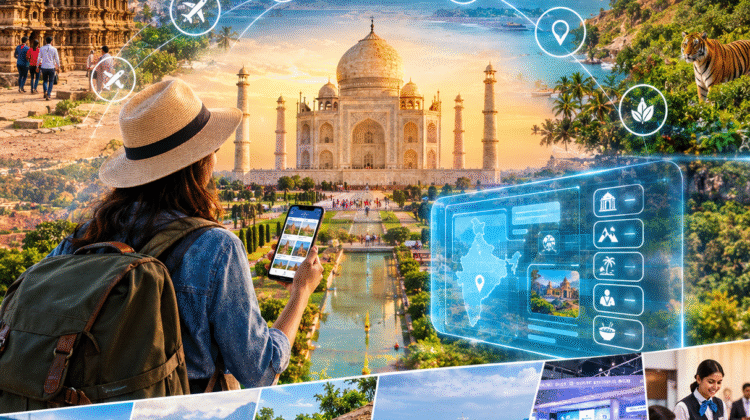
The central focus of World Tourism Day 2026 is the growing role of digital technology and artificial intelligence in tourism. The travel journey is moving from traditional maps and guidebooks towards smartphone-based discovery, digital bookings and increasingly personalised experiences. The Ministry’s approach places convenience, personalisation and seamless digital interaction at the centre of this transformation.
India’s e-Visa system is one example of this digital transition. Introduced in 2014 for nationals of 43 countries, it has expanded to 172 countries, with entry permitted through 88 international ports. Around 78% of visas issued by India are now electronic visas, while approximately 95% of e-Visa applications are processed within 72 hours.
The revamped Incredible India Digital Platform is taking the digital experience further by bringing cultural, heritage, adventure, gastronomical, wellness, art and craft, and rural attractions onto a common platform. Its AI-powered features are designed to personalise visitor experiences through services such as real-time weather information and city exploration. The platform also connects travellers with online travel agencies and tourism stakeholders for flights, hotels, transport and other services.
Another component is NIDHI+, the National Integrated Database of Hospitality Industry. The platform supports digital registration, recognition and classification of tourism service providers while enabling online processing, integrated payments and transparent approvals. As of 23 September 2026, NIDHI+ listed 63,740 accommodation units, 1,450 online travel aggregators and 15,531 tourism service providers, alongside convention centres and food business operators.
Taking tourism beyond the major cities
India’s digital tourism transformation is also being accompanied by a wider geographical expansion of tourism. Start-ups are emerging across travel technology, online booking, homestays, rural tourism, smart mobility and AI-enabled travel planning. The Ministry’s data notes that 58% of DPIIT-recognised tourism startups were based in Tier-II and Tier-III cities as of April 2023, highlighting the growing role of smaller urban centres in the tourism economy.
Government programmes such as Swadesh Darshan 2.0 are similarly shifting attention from individual attractions towards complete destination ecosystems. The programme adopts a destination-centric approach focused on sustainable and responsible tourism, experiences and visitor amenities. Under the broader Swadesh Darshan programme, 76 projects worth more than ₹5,295 crore were sanctioned across 15 thematic circuits, while Swadesh Darshan 2.0 has sanctioned 53 projects worth ₹2,207.08 crore.
Pilgrimage tourism remains another important area. Through PRASHAD, the government is supporting infrastructure and visitor facilities at identified pilgrimage and heritage destinations. Fifty-four projects worth ₹1,726.18 crore have been sanctioned, covering interventions ranging from tourist facilities and parking to waste management, solar infrastructure and safety systems.
New opportunities across tourism segments
India’s tourism landscape is becoming increasingly diversified. Wellness and medical tourism draw on the country’s traditions of Yoga and Ayurveda alongside modern healthcare facilities. Rural and community-based tourism is creating opportunities through homestays, local cuisine, handicrafts and village experiences.
Cruise tourism is another emerging segment. Sea cruise passenger traffic increased from 1.08 lakh in 2014-15 to 4.62 lakh in 2025-26, representing 328% growth. Technology is also being applied to improve the cruise journey, with QR-based immigration reducing clearance time to around 30 seconds per passenger.
India is also strengthening its MICE tourism ecosystem through major venues such as Bharat Mandapam, Yashobhoomi and Jio World Centre. The Ministry has identified the potential to develop at least 10 Indian cities, particularly in South India, as global MICE destinations.
Building the people behind tourism
Technology, however, remains only one part of the transformation. India is also investing in the people who deliver tourism services. Under the Capacity Building for Service Providers programme, training is provided across hospitality, tourism and allied services. Between FY 2020-21 and FY 2024-25, the programme trained more than 1.68 lakh people, with over 36,000 placed, according to a 2025 Quality Council of India evaluation. The Paryatan Mitra/Paryatan Didi initiative has additionally trained around 4,382 local service providers in hospitality, cleanliness, safety and sustainability.
For India, therefore, World Tourism Day 2026 represents more than a celebration of travel. It reflects a broader transition towards a tourism ecosystem where digital platforms, AI, infrastructure, skills, sustainability and community participation work together.
The next phase of Indian tourism is being shaped not only by where travellers go, but by how they discover destinations, how easily they can access them, how experiences are personalised and how much value tourism creates for local communities. The direction outlined for 2026 points towards a tourism sector that aims to be more connected, inclusive, sustainable and digitally enabled—while continuing to expand the geographical and economic footprint of travel across India.
This report is part of TheTravigator’s continuing news coverage of the travel, tourism, aviation, and hospitality sectors. Our editorial team publishes industry news, market insights, partnerships, policy developments, and business updates relevant to the travel trade community. For press releases, partnership opportunities, advertising enquiries, or editorial collaborations, please contact our editorial desk at:
INFO@THETRAVIGATOR.COM