Partition and the Broken Map How 1947 Redrew India’s Travel and Trade Routes
Partition and the Broken Map How 1947 Redrew India’s Travel and Trade Routes
A heritage-tourism perspective on the railway lines, markets, communities and regional connections disrupted when a shared geography became an international frontier.
Before 1947, the Indian subcontinent was connected by a vast network of railways, roads, markets and trading routes. These links were built to connect people—not to divide them.
Cities, towns and villages exchanged goods, ideas and traditions across regions that later found themselves separated by an international border. Railways carried passengers and merchandise, while roads and market routes sustained commercial relationships developed over generations.
Partition changed all of that.
In 1947, the division of India and Pakistan did more than redraw a political map. It disrupted the movement of people, fractured established trade networks and transformed familiar internal journeys into international crossings governed by visas, security checks and diplomatic uncertainty.
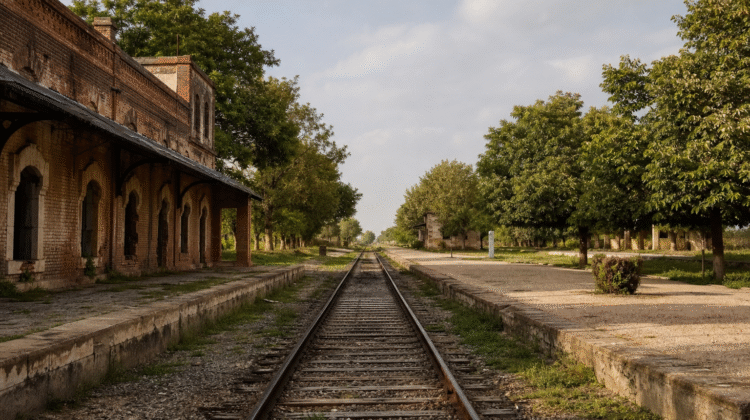
A railway line had become a symbol of a broken map.
The Jammu–Sialkot storyWhen a Regional Route Became an International Frontier
The Jammu–Sialkot Connection
Before Partition, Sialkot was a major commercial centre, and Jammu was connected to it through a railway network that supported the movement of passengers, traders and goods.
For generations, the route formed part of a shared regional economy. People travelled for business, family, education and religious purposes. Merchants relied on established supply chains, while communities on both sides maintained social and cultural connections.
Then, almost overnight, a familiar regional link became an international frontier.
The disruption of the Jammu–Sialkot connection was not simply the closure of a railway service. It represented the breaking of an economic geography that had evolved over centuries.
Markets lost traditional supply routes. Businesses were forced to search for new suppliers and customers. Families and communities were divided. Journeys that had once been routine became dependent on borders, permissions and security protocols.
The Route as a Heritage Experience
Today, the story of the Jammu–Sialkot connection raises an important question:
Can infrastructure once divided by geopolitics become an instrument of tourism, memory and reconciliation?
The revival of the old route as a heritage railway or tourism corridor has periodically attracted interest. Any such proposal would face serious diplomatic, security, infrastructure and regulatory challenges. Yet the idea remains compelling—not only because of the railway itself, but because of the history embedded in the route.
What the Heritage Corridor Could Tell
Even if the physical railway is not restored, the route can still be interpreted, documented and presented as a major heritage narrative.
Historic stations, surviving railway structures, abandoned alignments, old markets, archives and oral histories could become part of a wider tourism circuit. Museums, walking tours, documentary exhibitions and local storytelling could help visitors understand how the subcontinent travelled, traded and lived before the border hardened.
Beyond a Train Journey
For the travel industry, the proposition is potentially much larger than a heritage train.
A Jammu–Sialkot heritage corridor could form part of a specialised border-tourism product combining history, architecture, trade, culture and memory. Visitors could explore old railway towns, study archival maps, visit historic markets and hear personal accounts from communities whose lives were shaped by Partition.
A Wider Heritage-Tourism Product
Wagah–Attari has already demonstrated the public fascination with the India–Pakistan frontier. A wider heritage-tourism approach could add historical depth to that experience—moving beyond ceremony and spectacle to explore the complex human and economic history of the border.
Tourism with Responsibility
Partition Heritage Must Be Handled with Exceptional Care
The aim cannot be to turn one of the most painful chapters in South Asian history into a commercial spectacle. Any tourism initiative must preserve historical accuracy, acknowledge the immense human cost of Partition and give local communities a meaningful role in shaping the narrative.
The most powerful stories may not come from grand political speeches or official records. They may come from a railway ticket kept in a family trunk, a market remembered by an elderly resident or a recipe that survived the border.
These details give history a human face.
Memory as heritagePlanning for the Geography That Disappeared
There is also a larger lesson for policymakers and the travel industry.
Tourism infrastructure is usually planned around present-day geography. Yet some of the subcontinent’s most compelling stories belong to a geography that no longer exists.
The old railway lines, trading routes and market connections remind us that political borders are relatively recent constructions, while economic, social and cultural relationships often have much longer lives.
The Map May Change. The Memory of Connection Does Not.
The routes may be interrupted. The stations may fall silent. The map may be redrawn.
But the memory of connection remains.
A Route Worth Remembering
For policymakers, conservationists and tourism planners, the opportunity lies in transforming lost connections into heritage assets—carefully, respectfully and sustainably.
A revived Jammu–Sialkot heritage narrative, whether or not the physical railway is ever restored, could become a powerful example of how tourism preserves routes that history erased from the modern map.
It could tell visitors not only where people once travelled, but also how they lived, traded, celebrated and belonged to a shared world before Partition divided it.
The Railway May Be Silent. The Story Does Not Have to Be.
The railway may no longer carry passengers across the frontier.
This report is part of TheTravigator’s continuing news coverage of the travel, tourism, aviation, and hospitality sectors. Our editorial team publishes industry news, market insights, partnerships, policy developments, and business updates relevant to the travel trade community. For press releases, partnership opportunities, advertising enquiries, or editorial collaborations, please contact our editorial desk at:
INFO@THETRAVIGATOR.COM