Six Square Feet, Sold at a Markup: The Business Behind Aviation’s Service Culture
Six Square Feet, Sold at a Markup: The Business Behind Aviation’s Service Culture
A B2B briefing for hoteliers, carriers and luxury travel operators
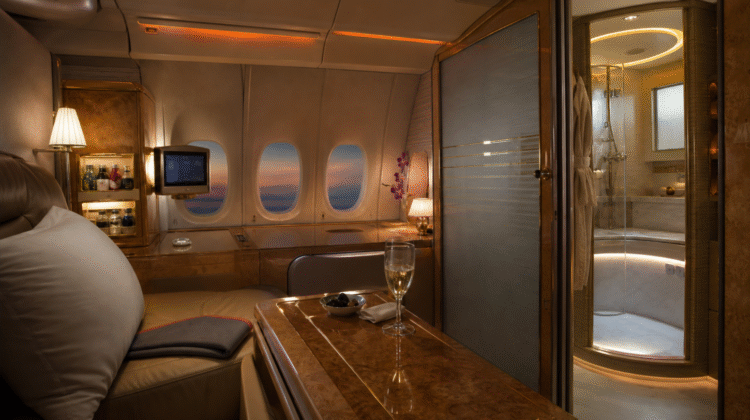
Emirates’ A380 First Class cabin is famous for its onboard shower spa, its Bulgari amenities, and a wine cellar that includes Château Mouton Rothschild. What’s less discussed is the ratio underneath it: on a ticket that regularly sells for $10,000 or more one-way, the physical soft product — food, drink, linens, amenities — accounts for a genuinely tiny slice of that fare, even allowing for premium pours, over-boarded entrées to guarantee choice, replaced crystalware, and the fuel penalty of hauling shower water at altitude. The overwhelming majority of what a First Class passenger pays for is not consumable at all. It’s space, privacy and staff attention — three things that cost the airline comparatively little to provision per passenger relative to what they’re sold for. That gap is not a footnote. It is, more or less, the entire business model of premium travel, and it did not start with aviation. It started on a railway.
Pullman: The Original Upgrade Economy
George Pullman never sold luxury. He sold an upgrade, and kept the difference. Pullman’s first sleeper, the Pioneer, dates to 1865 and gained national fame carrying Abraham Lincoln’s body from Washington to Springfield. But the commercial model sharpened two years later, in 1867, when Pullman launched The President — his first “hotel on wheels,” the car that added an attached kitchen and dining service to the sleeping-car concept. From The President onward, Pullman didn’t sell the cars to railroads outright — he leased them, kept operational control, and pocketed the extra fare each passenger paid to ride in one. The cars cost roughly five times what an ordinary railway carriage cost to build, marketed deliberately as “luxury for the middle class” rather than only the ultra-rich. Pullman porters — highly trained, meticulously turned out, expected to anticipate a passenger’s needs before being asked — were the labour that justified the premium. It was, structurally, the first modern version of a pattern every airline runs today: charge a large multiple over the base fare, spend a fraction of that multiple on the actual upgrade, and let attentive human service carry the rest of the perceived value.
The Ocean Liner Proves the Revenue Math
Ocean liners took the same idea and proved the revenue math at scale. On the Titanic, First Class carried only 693 of 2,393 possible passengers — under 29% of capacity — yet contributed roughly 68% of total ticket revenue. A standard First Class berth ran about £30; the grandest parlour suites, with private promenade decks and staff dedicated to a single cabin, went for as much as £870 — nearly thirty times the entry-level fare, on the same ship, arriving at the same port, at the same time. That ratio is the point: exclusivity aboard an ocean liner was never really about the crossing. It was a pricing structure built around space, privacy and personal service, stacked in tiers precisely so the top tier could subsidise the economics of the whole vessel.
Exclusivity was not the journey itself. It was a deliberately tiered pricing architecture built around space, privacy and personal service.
Early Aviation Borrowed the Hotel-at-Sea Model
Early aviation didn’t invent this. It borrowed it, brand and all. Pan Am’s Juan Trippe launched the “Clipper” naming convention as early as 1931, with the Sikorsky S-40, specifically to attach his airline to the prestige of the great ocean liners; pilots were called “captains” and dressed in naval-style uniforms, a direct lift from maritime service culture rather than anything aeronautical. Ellen Church became the first stewardess in 1930, hired partly because a uniformed, calm, nurse-trained presence reassured nervous passengers — the aerial equivalent of the Pullman porter’s anticipatory service. By the time the Boeing 314 Clipper — the zenith of that decade-long branding project, not its start — began flying transatlantic routes in 1939, Pan Am had built something closer to a floating hotel than an aircraft: dressing rooms, a dining salon, sleeper berths, even a honeymoon suite, with roughly 22 square feet of space per passenger — nearly four times what a modern economy passenger gets on about six square feet today.
The Jet Age Changed Access, Not the Tier Structure
The jet age democratised the ticket. It never democratised the tier structure. Commercial jets from the 1950s onward made flying accessible to a mass market, but airlines kept the Pullman-and-liner logic intact rather than discarding it — multiple cabins, differentiated by space and staff attention rather than speed, since every passenger arrives at the same time regardless of class. That logic has only sharpened. Delta now reports premium cabin revenue exceeding 50% of total revenue despite premium seats making up only 15–20% of capacity; industry-wide, a single business class passenger is estimated to generate revenue equivalent to five to ten basic economy passengers. Airlines are reportedly investing on the order of $20 billion industry-wide into new premium cabins through 2026 — what the trade press has taken to calling the “Suite Wars.” Emirates staffs its 14-suite A380 First cabin at roughly one crew member per two passengers, against one per six in Business; Singapore Airlines’ Suites product, at around 50 square feet per passenger and limited to just six seats per aircraft, prices a Singapore–New York return in the $23,000–$28,000 range. The square footage sold, not the food and drink poured into it, remains the product.
From Memory to Database
What’s genuinely new is that the anticipation is now a database, not a memory. A good Pullman porter or ocean-liner steward earned his reputation by remembering a passenger’s preferences across a single, days-long crossing. Etihad’s Residence and its equivalents at Emirates and Singapore now do the same thing across years and flights — a cabin crew that greets a passenger by name, already aware of a preferred Champagne or seating configuration, isn’t improvising warmth; it’s executing a CRM profile built from that traveller’s booking history. The service culture hasn’t changed in kind since 1867. It’s changed in scale — personal attention that once depended on one porter’s memory of one passenger is now infrastructure, applied consistently across an entire premium customer base.
Personalisation has moved from an individual employee’s memory to a repeatable data infrastructure. The result is the industrialisation of anticipatory service.
The Product Beneath the Product
The throughline, for anyone selling premium travel, is worth stating plainly. From Pullman’s leased sleeping cars to the consumable-versus-fare ratio inside a modern five-figure ticket, the commercial logic of first-class travel has never really been about the amenity itself. It’s about converting a small amount of physical space and human attention into a large multiple of fare, then using that margin to subsidise — and cross-sell into — everything else the carrier operates. Understand that, and the shower spa, the caviar, and the butler service stop looking like indulgences. They look like what they’ve always been: the visible tip of a 150-year-old pricing model.
EDITORIAL NOTE — THETRAVIGATOR.COM
This report is part of TheTravigator’s continuing news coverage of the travel, tourism, aviation, and hospitality sectors. Our editorial team publishes industry news, market insights, partnerships, policy developments, and business updates relevant to the travel trade community. For press releases, partnership opportunities, advertising enquiries, or editorial collaborations, please contact our editorial desk at:
INFO@THETRAVIGATOR.COM
This report is part of TheTravigator’s continuing news coverage of the travel, tourism, aviation, and hospitality sectors. Our editorial team publishes industry news, market insights, partnerships, policy developments, and business updates relevant to the travel trade community. For press releases, partnership opportunities, advertising enquiries, or editorial collaborations, please contact our editorial desk at:
INFO@THETRAVIGATOR.COM