Fuel Volatility vs. Long-Haul Capacity: Your 2026 Yield Management Survival Guide
The Bottom Line for Corporate Buyers
Jet fuel is projected to average $152 per barrel in 2026, up 69% year-over-year. Fuel now consumes 31.4% of airline operating costs, squeezing carrier margins to a razor-thin 2% net profit—half of 2025 levels. This isn’t a temporary spike. It’s a structural reset.
Why Your Long-Haul Fares Are Climbing
Airspace closures over Iran and Russia have narrowed Europe-Asia corridors to a 50-mile-wide strip over Azerbaijan. Qantas’s Perth-London flight now takes 3.5 hours longer. Air India suspended Delhi-Chicago entirely. These detours burn fuel airlines can’t hedge—many carriers hedged crude, not the jet fuel crack spread now averaging a historic $57/barrel.
The Forecast You Need to Budget Against
GBTA projects premium cabin fares rising 9.5% to $4,488 globally. Economy fares up 8.7%. Global airline earnings will halve to $23 billion.
Your Actionable Playbook
1. Lock in negotiated fares now. Airlines have hedged only one-third of 2026 fuel needs, leaving massive exposure. With premium demand still strong (bookings up 9%), carriers have little incentive to discount. Negotiate longer-term agreements before Q1 2027 renewals.
2. Target carriers with geographic advantages. Airlines avoiding Middle East hubs face fewer detour costs. Prioritize non-Gulf carriers for Europe-Asia routes.
3. Expect fuel surcharges to stick. These charges—up to $800 on long-haul business class—are largely non-negotiable. Budget for them explicitly rather than fighting them.
4. Review contract force majeure clauses. If your volume commitments assume capacity airlines can no longer deliver, renegotiate now.
The era of cheap long-haul business travel is over. Plan accordingly.
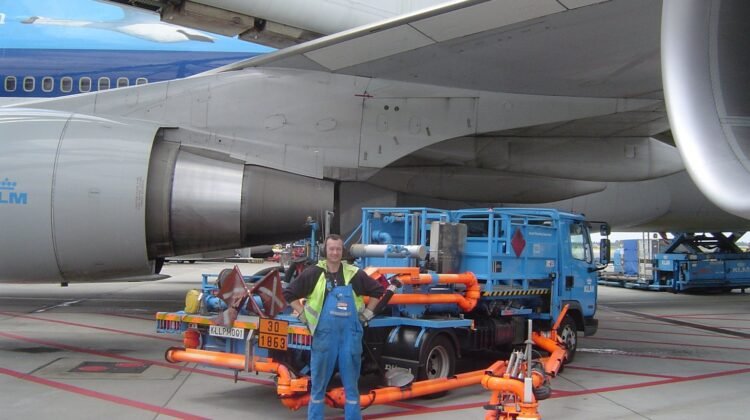
Featured photograph: Aircraft fuelling at Amsterdam Schiphol, 2004 (archive image). Saschaporsche / Wikimedia Commons, CC BY-SA 3.0. Resized for web.