

The OTA Tightrope
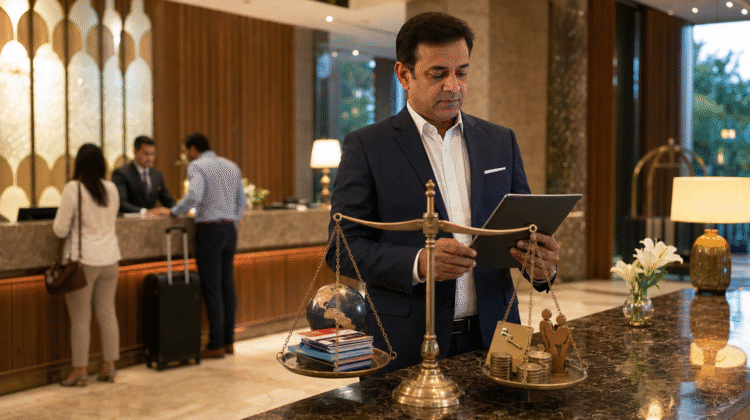
The OTA Tightrope: Why Smart Hoteliers Are Reclaiming Their Margins
OTAs remain essential for reach, but the most profitable hotels are learning to use them strategically while rebuilding direct relationships, first-party data, and channel control.
The Elephant in the Lobby
Let’s be honest—every hotelier has muttered something unprintable about OTAs while staring at a commission invoice. And who can blame you? When Booking Holdings and Expedia together vacuum up roughly two-fifths of global travel distribution, it’s easy to feel like you’re running a boutique hotel that just happens to subsidize a tech giant’s quarterly earnings.
But here’s the uncomfortable truth: OTAs aren’t going anywhere. They’re not the enemy. They’re a utility—like electricity or water. Essential, yes. But you wouldn’t build your entire business strategy around paying your electricity bill, would you?
OTAs are useful infrastructure. The mistake is allowing them to become the entire commercial strategy.
The Numbers That Keep You Up at Night
The OTA channel is a multi-hundred-billion-dollar behemoth that’s projected to keep growing. Two players dominate—Booking Holdings and Expedia—while regional heavyweights like MakeMyTrip hold their ground in specific markets.
Mobile is king. If your booking experience isn’t thumb-friendly, you’re losing guests before they’ve even checked your cancellation policy.
Commissions range from 10% to 30% depending on how much leverage you have. For independent hotels, that’s often closer to the higher end. Do the math: a ₹10,000 room night just cost you ₹3,000 in commission. That’s not pocket change.
OTAs excel at flights and accommodations, while tours and activities remain a smaller slice—but that slice is growing fast.
The commercial reality
The Strategic Tension: Reach vs. Margin
OTAs bring you guests. Without them, you’re invisible to millions of travellers. During off-peak seasons, they’re your lifeline. When entering new markets, they’re your megaphone.
But they also own your customer. The guest books through Booking.com, receives Booking.com emails, leaves a Booking.com review, and books again through the same platform. You’re paying for the privilege of being a supplier to someone else’s relationship.
What Smart Hoteliers Are Actually Doing
The industry’s most profitable properties aren’t fighting OTAs—they’re managing them like a chess game, not a boxing match.
1. Make the Direct Channel Irresistible
Not just functional. Irresistible.
Value-adds are especially important because they protect rate integrity. Breakfast, flexible checkout, room preferences, and complimentary experiences can make the direct channel more attractive without training guests to wait for discounts.
2. Use Metasearch as a Shield
Instead of letting OTAs dominate comparison shopping, smart hotels buy visibility on Google Hotels and other metasearch engines to show their direct rate alongside OTA rates. This reduces the customer’s need to comparison-shop and helps keep margins intact.
3. Play the Inventory Game
High-demand season? Reserve more inventory for direct bookings. Low-demand periods? Let OTAs absorb the unsold rooms. This isn’t favouritism—it’s revenue management 101.
4. Negotiate Like Your Margin Depends On It
Not all OTA promotions are created equal. Hotels should participate only where the incremental demand and net revenue justify the cost.
5. Become a Data Collector
Every direct booking yields first-party customer data—consent-based email addresses, preferences, and booking behaviour. That data fuels personalised offers, remarketing campaigns, and loyalty programmes that OTAs can’t touch.
The Indian Context: What Works Here
The Metrics That Actually Matter
Stop obsessing over occupancy. Start obsessing over profitability.
| Metric | Why It Matters |
|---|---|
| Direct booking share | Higher direct share usually means stronger margins. |
| OTA commission as % of revenue | If this is not falling, channel cost remains too high. |
| Net ADR by channel | Gross ADR hides commissions and promotional costs. |
| Website conversion rate | If it is below 2%, the user experience needs attention. |
| Mobile conversion rate | This is where a large share of guests now book. |
| Booking abandonment rate | High abandonment signals friction in the funnel. |
| Repeat guest share | The strongest defence against OTA dependency. |
Your 90-Day Playbook
The One-Sentence Summary for Your Board
Use OTAs for discovery, but make your direct channel faster, more valuable, and more profitable than any intermediary.
What to Do Right Now
For Indian hotels, a realistic target is a 10% to 20% lift in direct share, better conversion on mobile, and lower dependence on high-commission OTA promotions.
The Bottom Line
OTAs are distribution partners—not growth strategies. They’re utilities, not business models. The hotels that thrive will be the ones that use them strategically while building something OTAs can’t replicate: a direct relationship with the guest. Because at the end of the day, Booking.com doesn’t know your guest’s name when they check in. You do. That’s your advantage. Use it.
This report is part of TheTravigator’s continuing news coverage of the travel, tourism, aviation, and hospitality sectors. Our editorial team publishes industry news, market insights, partnerships, policy developments, and business updates relevant to the travel trade community. For press releases, partnership opportunities, advertising enquiries, or editorial collaborations, please contact our editorial desk at:
INFO@THETRAVIGATOR.COM