The Economic Rise of LGBTQ+ Travel
The Economic Rise of LGBTQ+ Travel: From Niche Market to Global Powerhouse
A fast-growing travel economy shaped by spending power, generational change, destination strategy, safety, technology, and authentic inclusion.
The Numbers Behind the Rainbow Economy
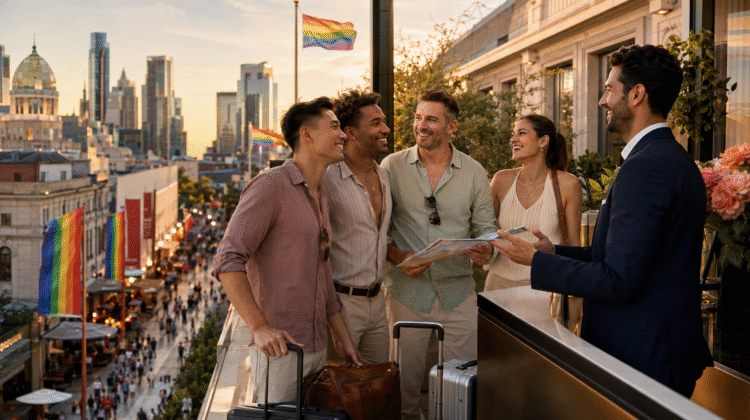
The LGBTQ+ travel sector has undergone a remarkable transformation, evolving from a niche submarket into an economic powerhouse that is fundamentally reshaping the global tourism landscape. This is no longer a fringe consideration for destination marketers—it is a multi-hundred-billion-dollar imperative that demands serious attention from the B2B travel fraternity.
The Billion-Dollar Reality
According to industry analysts, the global LGBTQ+ tourism market was valued at USD 385.56 billion in 2026, with projections to reach USD 604.34 billion by 2032, growing at a compound annual growth rate of 8.0%. Industry estimates corroborate these figures, placing the market at approximately USD 357 billion by the end of 2025. For context, this represents roughly 10% of the global travel industry—a segment too substantial to ignore.
The spending power of LGBTQ+ travellers is notably higher than the mainstream tourist demographic. Thai property developers have found that LGBTQ+ consumers exhibit spending power 40% higher than the average tourist, with strong preferences for luxury brands and demonstrated brand loyalty. In Thailand alone, LGBTQ+ tourists generate an estimated US$1.5 billion annually, accounting for approximately 0.3% of the country’s GDP.
LGBTQ+ travel is no longer a symbolic diversity conversation. It is a major commercial segment where values, safety, service, and spending power intersect.
The Demographics Driving Growth
The demographic shift underpinning this market expansion is striking. Recent data shows that 9% of U.S. adults now identify as LGBTQ+, a significant rise from 3.5% in 2012. Among travellers under 30, the figure climbs to nearly one in four (23%). This generational shift suggests that the market will only continue to expand as younger, more openly diverse travellers become the dominant consumer cohort.
U.S. Adults
Now identify as LGBTQ+, compared with 3.5% in 2012.Under 30
Nearly one in four younger travellers identify as LGBTQ+.Trips Per Year
Reported by 54% of respondents in one survey.Booking Spend
Spend between £500 and £2,000 per booking.Globally, the LGBTQ+ population is estimated at 388 million, with annual consumer spending power exceeding USD 4.7 trillion. These are travellers who take between three and five holidays per year (54% of respondents in one survey), with 63% spending between £500 and £2,000 per booking, and approximately 20% spending even more—between £2,000 and £5,000 per person per holiday.
Destination Strategies and Economic Returns
Destinations are waking up to the economic potential. Bangkok’s push for LGBTQ+ tourism began in earnest in 2013 with the “Go Thai. Be Free” campaign. The strategy paid off: Bangkok Pride 2025 drew over 300,000 participants, and the 2025 marriage equality legislation positioned Thailand as the first Southeast Asian nation to legalise same-sex unions.
Major Pride events generate substantial economic impact. Madrid Pride attracts around 2 million participants, generating over €109 million in spending. London Pride produces even higher per-capita spending, with total revenues exceeding €141 million. Across all examined destinations, the hospitality sector absorbs the majority of this spending, with more than 60% allocated to food and beverage services.
The Safety Paradox
However, the economic narrative is inseparable from the safety imperative. According to recent research based on insights from 13,300 LGBTQ+ travellers across 19 countries, the reality is sobering.
Travel Behaviour Is Being Shaped by Risk
44% of LGBTQ+ travellers are taking more precautions today than they did a few years ago. Common measures include sharing live locations with trusted contacts (25%), using VPNs for privacy (19%), deleting dating apps before crossing borders (16%), and carrying secondary phones (18%). Nearly half (48%) said they routinely assess their surroundings before showing affection to a partner in public.
The data also highlights a disturbing paradox: LGBTQ+ travellers who report the fewest negative experiences are those who identify as “not out”—the travellers most able to conceal their identity. Only 31% of respondents globally said they are out while travelling, compared with 68% who are out to close friends. Even more telling, 40% said they would be willing to hide their identity to visit a bucket-list destination.
The visibility gap
Transgender travellers report increased anxiety
This compares with a global average of 27%, with gender-specific facilities emerging as a leading concern.
Transgender travellers face the most acute challenges. They are the only group in which the percentage reporting increased travel anxiety exceeds those who have become more relaxed—43% have become more anxious about travel, compared with a global average of 27%. The use of gender-specific facilities, such as bathrooms and changing rooms, is their leading concern (24%).
Approximately 65 countries still criminalise homosexuality in some form, with penalties ranging from imprisonment to death. Authorities in some countries could be involved in entrapment campaigns, with law enforcement monitoring websites, mobile phone apps, or meeting places.
The Industry Response
The travel industry is responding. One major hospitality platform launched a training program in 11 languages that has been completed by more than 142,000 properties, enabling travellers to search for LGBTQ+-friendly accommodations in over 20,000 cities worldwide.
Scaling Inclusive Hospitality
Leading travel associations have launched toolkits identifying three core “Power Values” that uniquely motivate LGBTQ+ travellers—Harmony, Health & Well-Being, and Balance—and translating these insights into actionable destination strategies. The research draws on insights from over 1,800 LGBTQ+ travellers across key international inbound markets.
Future Trajectory
Technology is playing an increasingly important role. 66% of LGBTQ+ travellers used AI tools to plan a trip during the past year. Among them, 43% said they trust AI to provide objective and non-judgmental travel advice related to their identity, while 39% believe AI is effective at identifying niche LGBTQ+-friendly venues that may be difficult to find through traditional search methods.
AI and LGBTQ+ Travel Planning
From Niche Segment to Mainstream Economic Driver
For the B2B travel fraternity, the message is clear: LGBTQ+ travel is no longer a niche but a mainstream economic driver. Destinations and suppliers that embrace authentic inclusivity—beyond symbolic gestures—stand to capture a lucrative, loyal, and fast-growing market segment. Those that fail to address safety concerns and demonstrate genuine commitment risk being left behind in a sector where values increasingly drive spending decisions.