Libya: A Land of Extraordinary Heritage
Libya: A Land of Extraordinary Heritage, Told with Care and Respect
Libya’s heritage story
Some destinations are celebrated for what they offer today.
Others are remembered for what they have safeguarded for thousands of years.
Libya belongs firmly to the latter.
Long before modern borders were drawn, this vast country connected the Mediterranean with the Sahara, welcoming Phoenician traders, Greek settlers, Roman emperors, Arab scholars and Berber communities.
Their legacy still survives in magnificent archaeological sites, ancient desert settlements and a coastline that stretches for nearly 2,000 kilometres.
Yet Libya’s story today cannot be separated from its current realities.
It is a country of remarkable historical significance whose tourism potential remains largely unrealised because of ongoing security challenges.
If there is one lesson I carried away while researching Libya’s remarkable heritage, it is that this is not a destination to approach casually.
It deserves admiration, curiosity and, above all, responsible planning.
For Indian travellers, Libya should be viewed less as a conventional holiday destination and more as one of North Africa’s great cultural treasures that may become more accessible as conditions evolve.
Tripoli and the Mediterranean gateway
The journey begins in Tripoli, Libya’s capital and its historic gateway to the Mediterranean.
The city’s old quarter, known as the Medina, reflects centuries of Arab, Ottoman and Italian influences.
Whitewashed buildings, shaded alleyways and traditional markets reveal glimpses of everyday Libyan life, where merchants continue to sell handwoven carpets, embroidered garments, leather goods and aromatic spices.
The historic Red Castle (Assaraya al-Hamra) dominates the waterfront, standing as a symbol of the city’s long and complex history.
Walking through Tripoli’s traditional souks—when conditions permit and under appropriate local guidance—offers an insight into Libyan hospitality.
Shopkeepers are known for welcoming visitors with Arabic coffee or sweet mint tea, often beginning conversations with questions about family, home and culture.
Hospitality remains deeply rooted in Libyan society, where generosity towards guests is considered a point of pride.
Leptis Magna, Sabratha and Cyrene
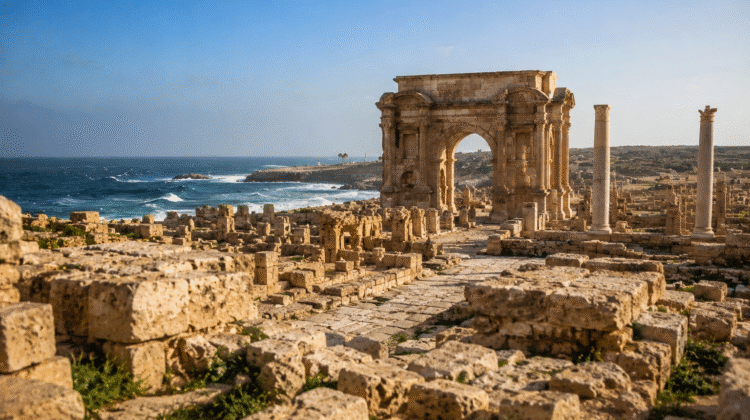
Among Libya’s greatest treasures is Leptis Magna, widely regarded as one of the finest Roman archaeological sites in the world.
Situated along the Mediterranean coast, the ancient city contains remarkably preserved amphitheatres, marketplaces, triumphal arches and public baths that rival those found anywhere in Europe.
Walking through its monumental streets is like stepping into a perfectly preserved chapter of the Roman Empire.
Unlike many famous archaeological sites, Leptis Magna has historically offered visitors the rare experience of exploring grand ruins without overwhelming crowds.
Its exceptional preservation is undoubtedly Libya’s strongest tourism USP.
Equally impressive is Sabratha, another UNESCO World Heritage Site renowned for its magnificent Roman theatre overlooking the Mediterranean Sea.
Once an important Phoenician trading port before flourishing under Roman rule, Sabratha beautifully illustrates Libya’s position as a crossroads of ancient civilizations.
The combination of coastal scenery and classical architecture creates one of North Africa’s most remarkable historical landscapes.
Further east lies Cyrene, founded by Greek settlers in the 7th century BCE.
Set amid the lush Green Mountain region (Jebel Akhdar), Cyrene presents a different perspective on Libya’s ancient past.
Temples, sanctuaries, theatres and colonnaded streets reveal the influence of Greek civilisation in North Africa.
The site’s elevated setting, surrounded by rolling hills rather than desert, surprises many visitors and highlights Libya’s remarkable geographical diversity.
Desert landscapes and oasis culture
Beyond its celebrated archaeological sites, Libya possesses extraordinary desert landscapes that remain largely unknown to international travellers.
The vast Acacus Mountains, located in the Libyan Sahara, are famous for dramatic sandstone formations and prehistoric rock art that documents thousands of years of human life in the desert.
Nearby, the Ubari Lakes, shimmering like turquoise jewels amid endless sand dunes, create one of the Sahara’s most surreal landscapes.
These remote regions have long fascinated geologists, photographers and desert explorers, although travel remains highly dependent on prevailing security conditions and specialist logistical support.
The ancient oasis town of Ghadames, often called the “Pearl of the Desert,” represents one of Libya’s most culturally significant destinations.
This UNESCO-listed settlement is celebrated for its ingenious mud-brick architecture designed to withstand the harsh desert climate.
Covered alleyways provide shade from the intense sun, while beautifully decorated homes demonstrate centuries of traditional craftsmanship.
Historically, Ghadames served as an important stop along trans-Saharan trade routes connecting North Africa with sub-Saharan Africa.
Culture, cuisine and living memory
Libyan culture reflects the rich traditions of Arab and Amazigh (Berber) communities shaped by centuries of Mediterranean and Saharan influences.
Traditional music, storytelling and poetry remain integral to community life, while handcrafted textiles, silver jewellery and woven carpets continue to showcase remarkable artisan skills.
Family plays a central role in society, and hospitality is deeply embedded in everyday customs.
The country’s cuisine reflects its geography and history.
Couscous is a staple, often served with lamb, vegetables and fragrant spices, while dishes such as Bazeen, a traditional barley dough served with richly flavoured meat stew, represent uniquely Libyan culinary traditions.
Fresh dates, olives, seafood along the Mediterranean coast and sweet pastries flavoured with honey and nuts highlight the country’s agricultural diversity.
What distinguishes Libya is not only its monuments but also the stories connected to them.
Local historians, archaeologists and community elders have long preserved knowledge of ancient trade routes, desert survival techniques and cultural traditions that have endured across generations.
These human stories give meaning to Libya’s extraordinary landscapes and remind visitors that history here is still very much alive.
Responsible Travel Context
For Indian travellers, any consideration of Libya must begin with careful preparation rather than itinerary planning.
Responsible planning for Indian travellers
For Indian travellers, however, any consideration of Libya must begin with careful preparation rather than itinerary planning.
Tourism infrastructure remains limited, and accessibility varies significantly depending on current conditions.
Independent travel is generally not advisable.
Anyone considering travel should closely monitor official government travel advisories, work only with highly experienced and verified local operators where travel is considered feasible, obtain comprehensive travel insurance that covers the destination and remain fully informed about evolving security conditions.
Travel plans should remain flexible, and compliance with local regulations and guidance from authorities is essential.
Libya’s long-term tourism relevance
Libya is best understood today as a destination of immense historical value rather than mainstream leisure tourism.
Its archaeological sites rank among the finest in the Mediterranean, its desert landscapes are breathtakingly beautiful and its cultural heritage is profoundly significant.
Yet these qualities must always be presented alongside an honest understanding of current realities.
Libya’s greatest USP lies in its extraordinary archaeological wealth combined with its strategic role in the history of Mediterranean and Saharan civilizations.
Few places preserve such remarkable Roman, Greek and desert heritage in one country.
While widespread tourism awaits more stable conditions, Libya continues to inspire historians, archaeologists and culturally curious travellers who appreciate the importance of preserving the world’s shared heritage with patience, responsibility and respect.
B2B Industry Take
Libya is not currently a mainstream leisure destination and should be approached primarily as a specialist heritage and research market.
For the travel trade, its relevance lies in long-term destination planning, archaeological tourism potential and policy awareness.
Operators should prioritise compliance with official advisories, verified local partnerships and responsible risk communication over commercial promotion until conditions permit broader tourism.