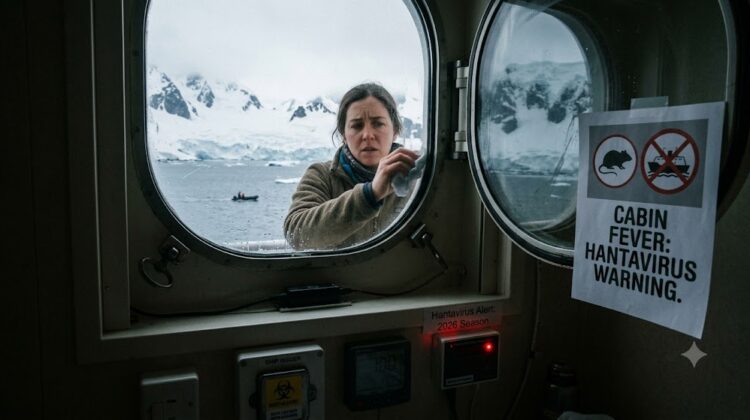
The Cabin Fever That Killed: Hantavirus Strikes an Antarctic Cruise
Three deaths, eight infections, and a 42-day quarantine that has shaken expedition cruising.
Ushuaia, Argentina April 1, 2026. The MV Hondius , a polar-class expedition vessel carrying 147 souls 86 passengers and 61 crew from 23 countries—slips out of the Beagle Channel. Destination Antarctica, then the remote archipelagos of the South Atlantic. For the Indian travel agent who booked even one client on a similar itinerary, this voyage will become a professional nightmare within days.
April 6, 2026 – Day 5 at sea. A passenger develops fever, severe muscle aches, and fatigue. Ship doctors log it as suspected influenza. They are wrong.
April 13, 2026 – Day 12. That same passenger is medically evacuated. Within hours, the diagnosis lands like a depth charge Andes virus a strain of hantavirus. Unlike almost every other hantavirus known to science, Andes virus can move from human to human through close, prolonged contact. Respirations, saliva, perhaps even a shared cabin ventilation duct.
By early May 2026 , the World Health Organization confirms eight cases (six laboratory-confirmed, two suspected).Three passengers are dead. A case fatality rate of nearly 38% the same statistical territory as untreated Ebola, but moving silently through a luxury cruise ship.
The MV Hondius changes course. Not toward a hospital, but toward Santa Cruz de Tenerife, Spain , for disembarkation. Passengers scatter across continents: France sends its citizens to biocontainment units . Australia imposes quarantine facilities . The Netherlands opts for home isolation . The WHO quietly recommends a 42-day monitoring period —echoing the incubation range of 4 to 42 days.
For the Indian outbound trade, this is not an Antarctic problem. This is a protocol problem .
What is Hantavirus? A Very Short History
The virus first announced itself in blood. During the Korean War (1950–1953) , over 3,000 United Nations soldiers fell to a mysterious illness causing fever, kidney failure, and bleeding— Hemorrhagic Fever with Renal Syndrome (HFRS) . The cause remained unknown until 1976 , when South Korean virologist Professor Lee Ho Wang isolated it from hamster lungs. He named it Hantaan virus , after the Hantan River. By 1988 , he had developed Hantavax , a vaccine still used in parts of Asia.
But hantavirus had a second, deadlier disguise. In 1993 , the southwestern United States saw young, healthy Navajo adults develop cough and fever, then drown in their own lung fluid within hours— Hantavirus Pulmonary Syndrome (HPS) . The culprit: Sin Nombre virus (“no name”), spread by deer mouse droppings, not humans. Family clusters were traced to shared rodent exposure in homes , not person-to-person transmission.
Today, the Hantaviridae family infects shrews, bats, fish, and even reptiles across Asia, Europe, and the Americas. But the MV Hondius outbreak involves Andes virus , which breaks the rodent-only rule. A 2024 study detected Andes virus RNA in human saliva and respiratory secretions —suggesting coughs and close cabin quarters may be enough.
How Did It Get Onboard?
The first case developed symptoms just five days after departure . Incubation for Andes virus typically ranges 2 to 4 weeks . That timeline strongly suggests the passenger was infected before boarding —possibly during a pre-cruise bird-watching excursion in rural Argentina involving rodent contact.
The second case was a close contact of the first. Human transmission or shared exposure? Unknown.
The third case had no family link to the first two. That raises the darkest question: Is Andes virus more contagious in closed-loop air conditioning systems than we thought?
Scientists admit they do not know definitively whether people are infectious before symptoms appear —the silent spread nightmare that defined COVID-19.
Remedial Measures: What the Trade Must Know
No specific antiviral treatment exists. No vaccine is available globally (Hantavax is not WHO-prequalified for international travel). Intensive care support is the only defense. The 38% case fatality rate applies once severe respiratory symptoms appear.
For travel agents and DMCs selling expedition cruises to Antarctica, Patagonia, or the Andean region:
- Pre-travel advisory must now include explicit warnings against rodent contact in rural South America.
- Cleaning protocols for clients: Never sweep or vacuum rodent droppings—aerosolization spreads the virus. Use disinfectant and wet-wipe methods.
- Symptom vigilance : Fever, fatigue, and muscle aches (especially thighs, hips, back, shoulders) appearing within 6 weeks of travel require immediate ICU referral .
- Quarantine literacy : WHO’s 42-day monitoring for close contacts will disrupt onward travel plans. Your clients need travel insurance that explicitly covers infectious disease quarantine . The B2B Take (50 words) Sharp Industry Analysis: Expedition cruising just acquired a biosecurity liability. Indian agents selling Antarctica or Patagonia must now vet DMCs for hantavirus preparedness—air filtration, onboard isolation units, and evacuation contracts. Margin erosion from cancellations will hit Q3 2026. Diversify to low-risk rail or river products immediately.