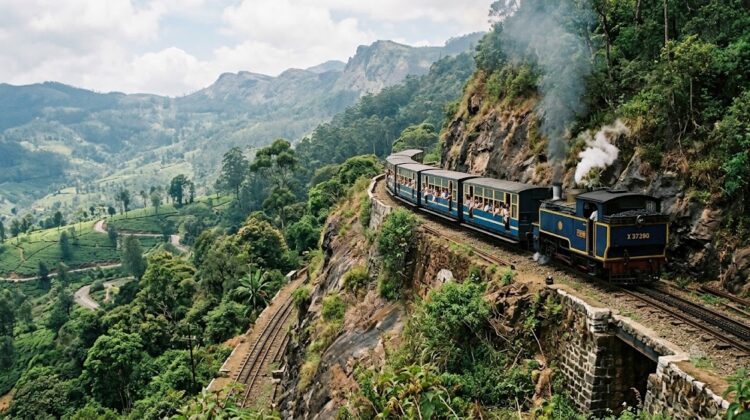
Why India’s Mountain Railways Are the World’s Most Unique Train Experiences
By TheTravigator Editorial Desk
In an era of high-speed bullet trains and hyperloop promises, there exists a parallel universe of rail travel where speed is deliberately sacrificed for spectacle. These are UNESCO’s mountain railways – where locomotives chug at 10 kilometers per hour, passengers lean out of windows for photographs, and the journey itself becomes the destination.
India, remarkably, is home to four of these rail heritage wonders, more than any other nation.
The Darjeeling Himalayan Railway (UNESCO 1999)
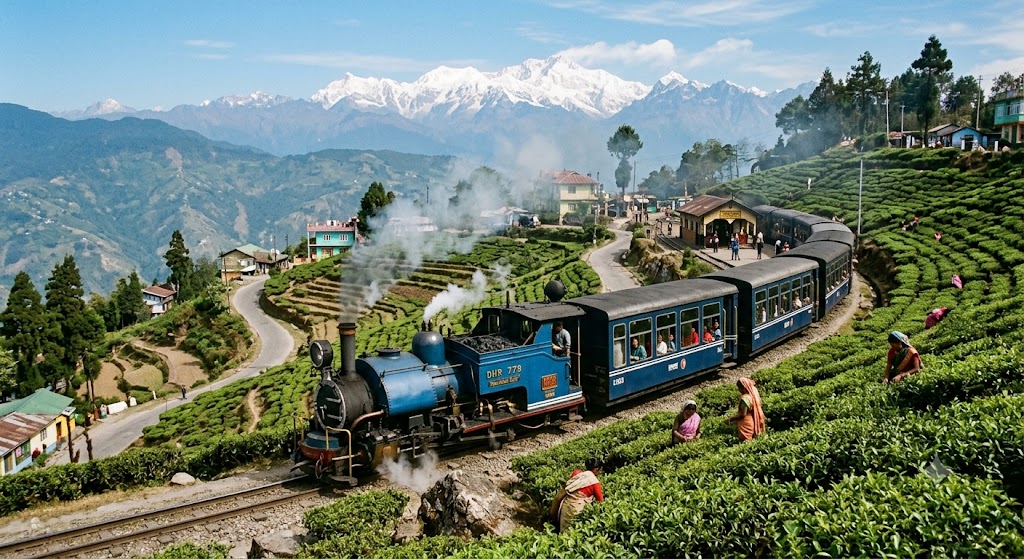
Affectionately called the “Toy Train,” this 88-kilometer narrow-gauge railway was Asia’s first to receive World Heritage status. Built between 1879 and 1881, it climbs from New Jalpaiguri (just 328 feet above sea level) to Darjeeling at 7,407 feet – a vertical ascent of over 7,000 feet .
To conquer the steep terrain, British engineers devised an ingenious system of six zig-zags (where the train reverses direction) and five loops (spiral tunnels that allow altitude gain within a limited space) . The most famous is the Batasia Loop, offering panoramic views of the Kanchenjunga massif.
What makes it unique
The train runs through working tea estates, past tiny hill villages, and across century-old iron bridges. At Ghum station (India’s highest railway station at 7,407 feet), a small railway museum documents the line’s storied past.
The Nilgiri Mountain Railway (UNESCO 2005)
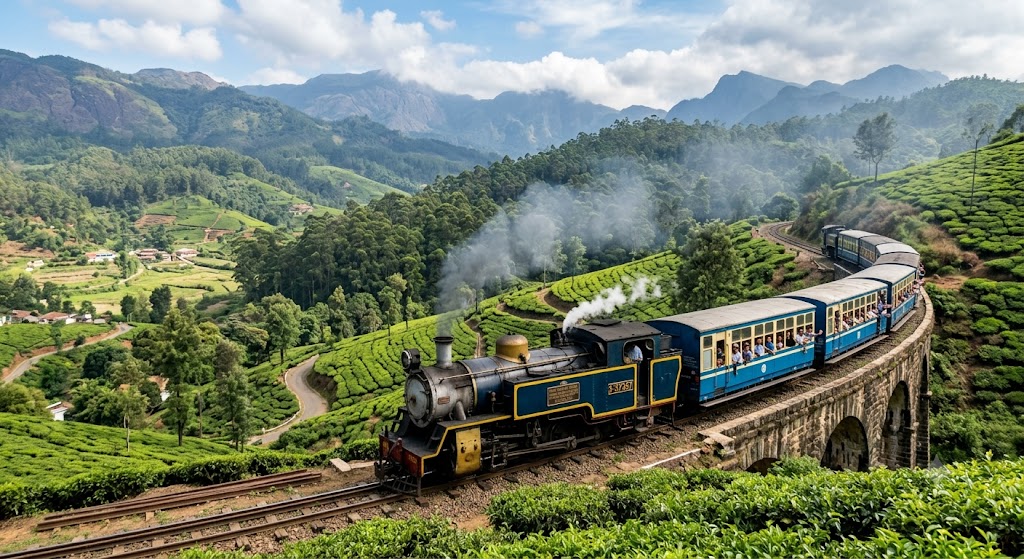
Connecting Mettupalayam (1,069 feet) to the misty hill station of Ooty (7,200 feet), this 46-kilometer route is a marvel of rack-and-pinion technology – the only operational steam-powered rack railway in India .
Unlike conventional trains that rely on wheel adhesion, the rack-and-pinion system uses a toothed rail between the tracks, engaged by a cogwheel on the locomotive. This allows the train to safely climb gradients as steep as 1 in 12.5 – a slope that would be impossible for a regular train .
As it winds through the Nilgiri Biosphere Reserve, passengers pass through 16 tunnels , cross 250 bridges , and navigate 208 curves . The journey takes approximately five hours to cover just 46 kilometers – slower than a brisk walk.
What makes it unique
The line still uses steam locomotives for portions of the ascent, making it one of the few places in the world where travellers can experience authentic steam rail travel through virgin rainforest.
The Kalka-Shimla Railway (UNESCO 2008)
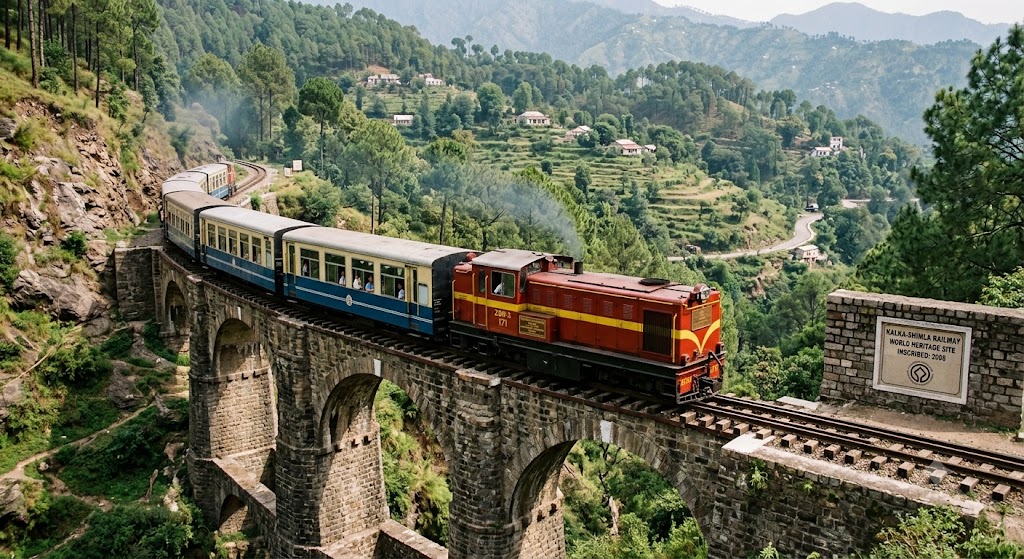
Opened in 1903 as the “British Jewel of the Orient,” this 96.6-kilometer narrow-gauge line was designed to connect the summer capital of British India (Shimla, then Simla) with the plains below .
The engineering statistics are staggering: the route passes through 107 tunnels (including the famous Barog Tunnel No. 33, which took three years to complete) and crosses 864 bridges and viaducts . The line climbs from Kalka (2,150 feet) to Shimla (6,811 feet) – a vertical rise of over 4,600 feet.
What makes it unique:
The early morning train offers the most spectacular views, revealing the Shivalik ranges in golden light. Unlike the other mountain railways, this line remains fully operational year-round, with modern diesel railcars now supplementing the heritage steam service.
The Architectural Wonder: CSMT (UNESCO 2004)
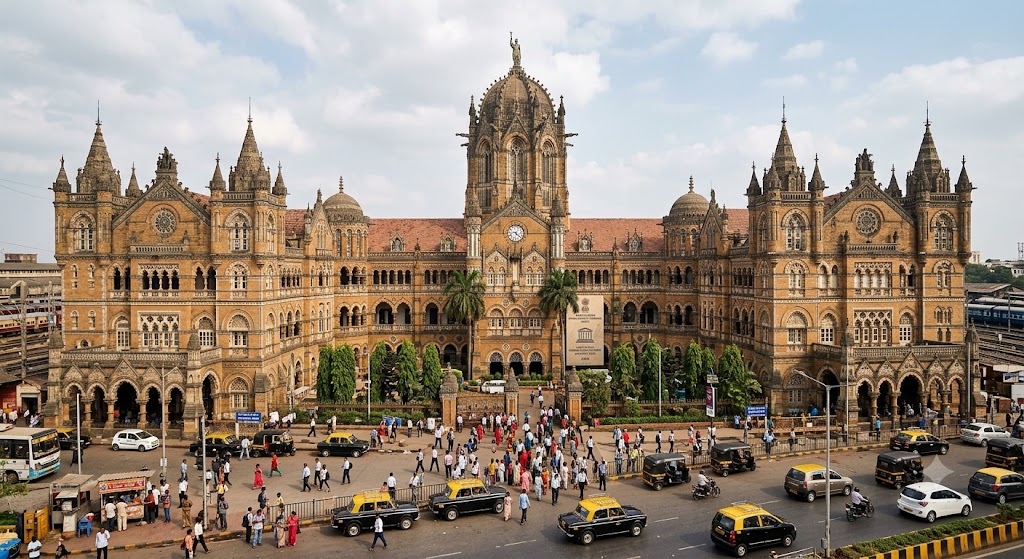
While not a railway line, the Chhatrapati Shivaji Maharaj Terminus in Mumbai deserves mention. Designed by British architect F.W. Stevens and completed in 1887, this Gothic Revival masterpiece incorporates traditional Indian courtyard architecture, domes, and turrets.
What makes it unique:
UNESCO describes it as “an outstanding example of Victorian Gothic Revival architecture adapted to Indian climate and sensibilities.” It remains a functioning railway station serving over 3 million passengers daily – arguably the busiest heritage site on the planet.
Why UNESCO Recognition Matters
According to UNESCO’s official citation, India’s mountain railways are “outstanding examples of bold, ingenious engineering solutions to the problem of establishing an effective rail link through a difficult mountain terrain.”
More practically, UNESCO listing brings:
- International funding for preservation and maintenance
- Legal protection against encroachment or modernization
- Global tourism visibility – each railway now attracts heritage travellers from over 50 countries annually
The Verdict: Ride Before They Retire
These railways are not mere tourist attractions. They are living, breathing operational heritage – some still running on original 19th-century tracks and bridges. Railway enthusiasts travel from across Europe, Japan, and the Americas specifically to experience India’s “toy trains.”
For the discerning traveller, a UNESCO rail journey is not a commute. It is a pilgrimage through industrial history, a slow-moving museum, and quite possibly – as the Telegraph once described the Kalka-Shimla line – “the best train ride of your life.”