Forests, Futures and the New Economics of Travel
In the dense sal forests of Bastar Chhattisgarh, where tribal communities have lived in harmony with nature for centuries, a new development story is taking shape one that could redefine how India measures prosperity and how destinations build tourism sustainably.
Chhattisgarh has become the first Indian state to link its forest ecosystem directly with Green Gross Domestic Product (Green GDP), marking a significant shift in the way economic growth is understood. At a time when destinations worldwide are struggling to balance tourism growth with ecological preservation, the state’s approach offers an important lesson: forests are not obstacles to development; they are economic assets.
The decision arrives at a critical moment for the global travel industry. Sustainability is no longer a niche conversation confined to policy forums or environmental campaigns. For destinations, tour operators, hospitality groups, and investors, it has become central to long-term viability. Chhattisgarh’s model demonstrates how environmental conservation, community welfare, and tourism development can work together rather than compete against one another.
Understanding Green GDP and Why It Matters
Traditionally, Gross Domestic Product (GDP) has measured the total value of goods and services produced within a country. Yet economists have long criticised the model for ignoring environmental degradation and resource depletion. Simon Kuznets, the architect of GDP, himself warned that national income figures could not fully capture societal welfare.
Green GDP attempts to correct that imbalance. It factors in the environmental cost of economic activity, including deforestation, pollution, and depletion of natural resources. According to the World Bank framework, Green GDP is calculated by subtracting the costs of natural resource depletion and ecosystem degradation from Net Domestic Product (NDP).
For Chhattisgarh, where forests cover nearly 44.2% of the state’s geographical area, this shift carries enormous significance. According to the India State of Forest Report 2023, the state recorded the highest increase in forest cover in the country, adding approximately 683.62 square kilometres. Beyond their environmental value, these forests support millions of livelihoods through tendu leaves, lac, honey, medicinal plants, and forest-based economies deeply tied to tribal life and cultural traditions.
In many parts of Bastar and surrounding regions, sacred groves such as Sarna and Mandar are not merely landscapes they are spiritual ecosystems woven into local identity. By integrating forests into Green GDP calculations, the state is effectively recognising that ecological wealth contributes to economic resilience.
Tourism and Environmental Accounting Begin to Converge
What makes this development particularly relevant for tourism is how closely Chhattisgarh has aligned environmental accounting with destination planning.
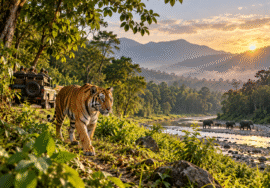
The state is positioning itself as a leading eco-tourism and nature-based travel destination, leveraging its forests, waterfalls, biodiversity, and tribal heritage. Destinations such as Kanger Valley National Park, Indravati Tiger Reserve, Achanakmar-Amarkantak Biosphere Reserve and Chitrakote Waterfall are increasingly being promoted as low-impact, immersive experiences rather than mass-tourism attractions.
Instead of encouraging unchecked visitor growth, Chhattisgarh Tourism has adopted carrying-capacity-based development models designed to minimise ecological stress. Nature trails, eco-ethno-adventure circuits, wellness retreats, and meditation pathways are being developed with sustainability at the core.
Community-Led Tourism at the Centre of the Strategy
Equally important is the state’s emphasis on community-led tourism.
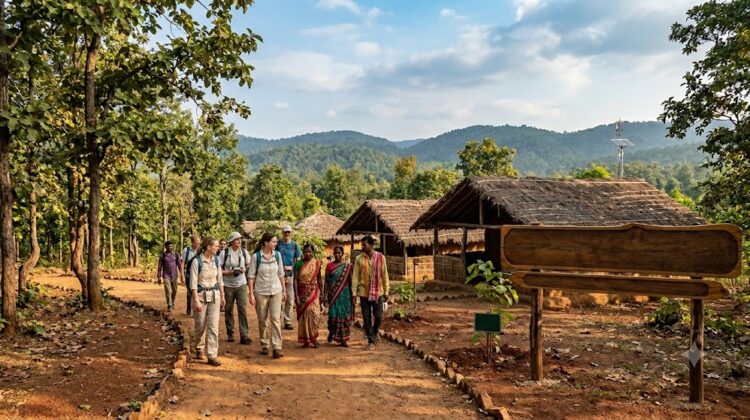
Under the Chhattisgarh Homestay Policy 2025–30, local communities—particularly tribal groups—are being encouraged to operate home stays, guided nature walks, handicraft experiences, and cultural programmes. The objective is not only to diversify tourism products but also to ensure tourism revenue flows directly into grassroots economies.
For many rural families, this model creates an alternative source of livelihood that reduces dependence on extractive economic activities. Homestay owners are also being trained in eco-friendly operations, waste management, and visitor safety, ensuring tourism growth remains aligned with environmental goals.
This grassroots approach reflects a broader shift taking place across global tourism markets. Travellers are increasingly seeking meaningful, responsible, and experience-driven journeys rather than conventional sightseeing itineraries. Chhattisgarh’s tribal circuits and forest-based experiences align naturally with this demand.
Conservation, Wildlife Protection, and Tourism Revenue
The state has also begun linking eco-tourism with human-wildlife conflict mitigation. Around protected areas, tourism revenue is being used to support conservation programmes, wildlife monitoring initiatives, and community awareness campaigns. By creating economic value around conservation, local communities gain stronger incentives to protect biodiversity rather than view wildlife as a threat to livelihoods.
For the travel trade, this opens significant opportunities.
Destination Management Companies (DMCs), experiential tour operators, and even MICE planners are increasingly searching for products that meet ESG and sustainability benchmarks. Chhattisgarh’s eco-cultural circuits offer a framework for responsible tourism products built around small-group travel, local partnerships, and regenerative experiences.
Corporate groups looking to integrate CSR-linked travel or sustainability-driven retreats may also find value in partnerships with local Self-Help Groups (SHGs), cooperatives, and community tourism networks across the state.
The Challenges Behind the Green GDP Framework
Yet the Green GDP framework is not without challenges.
One major concern lies in how “forest cover” is defined. Current reporting systems often include commercial plantations such as oil palm and rubber under forest statistics, despite their lower ecological value compared to natural forests. Critics warn that if states focus on quantity over quality, environmental accounting could become misleading.
There are also concerns around data transparency, political misuse, and whether financial benefits will genuinely reach forest-dwelling communities who have protected these ecosystems for generations.
Experts argue that the success of Green GDP will ultimately depend on transparent methodologies, public scrutiny, and stronger local participation. Restoring native forests, rather than relying solely on plantation drives, will be essential for achieving meaningful biodiversity and climate outcomes.
A Blueprint for Regenerative Tourism Growth
Still, Chhattisgarh’s move represents something larger than an accounting reform. It signals a new way of thinking about destination development—one where forests, culture, and communities are treated as long-term assets rather than expendable resources.
For the tourism industry, that message matters.
As travellers become more conscious of environmental impact and destinations face mounting pressure from climate change, the future of tourism may depend less on how many visitors arrive and more on how responsibly those journeys are managed.
In that sense, Chhattisgarh is not simply protecting forests. It is building a blueprint for a more regenerative travel economy—one where growth is measured not only by revenue, but by the health of ecosystems and the resilience of communities that sustain them.
This report is part of TheTravigator’s continuing news coverage of the travel, tourism, aviation, and hospitality sectors. Our editorial team publishes industry news, market insights, partnerships, policy developments, and business updates relevant to the travel trade community. For press releases, partnership opportunities, advertising enquiries, or editorial collaborations, please contact our editorial desk at:
INFO@THETRAVIGATOR.COM