The Day After the Mela: What Indian Travel Trade Really Wants from SATTE and OTM — and What Organisers Must Answer in 2027
A business card is not a customer. An MoU is not revenue. A meeting is not a booking.
Every January and February, Indian travel trade performs the same ritual: pavilions rise in Delhi and Mumbai, business cards change hands, MoUs are signed, photographs are taken, and everyone goes home. Then the real question begins — the one nobody wants to ask on stage.
When average operating margins in Indian travel trade have compressed to 3%–7%, when a DMC founder privately admits “the market keeps pushing us toward competitive pricing while ground costs — hotels, logistics, operations — keep rising,” and when one tour operator puts his margin at 6.5%–7% while peers report 10%–15% profit erosion, every rupee spent on a stall, a hosted buyer programme or a return airfare must be justified to a board. SATTE and OTM can no longer be evaluated on exhibitor counts and pre-scheduled meetings. They must be judged on what happens after the doors close.
This paper asks three uncomfortable questions: What does the industry actually want from these shows? What must organisers watch for in 2027? And which questions are being carefully avoided?
Part One: What the Industry Actually Wants — Verified Conversion, Not Visibility
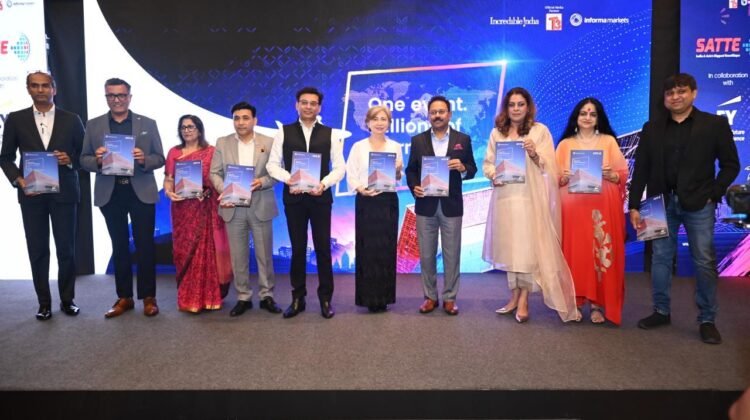
SATTE 2026, per the EY study released in July 2026, generated ₹193 crore in direct economic impact, 50,000+ hotel room nights, 45,000+ employment man-days, 25,000+ flight bookings; 89% of exhibitors reported generating business leads and 92% intended to return. A later October 2026 announcement cited an estimated ₹3,000 crore in direct and indirect impact. OTM 2027 projects 2,200+ exhibitors, 50,000+ trade visitors, 1,000+ hosted and VIP buyers, and 32,000+ pre-scheduled meetings.
Read those numbers carefully. They measure activity, not outcome. Hotel room nights benefit the host city, not the exhibitor’s P&L. “Leads generated” is stage one of a five-stage pipeline. “Intended to return” is sentiment, not revenue. Neither SATTE nor OTM, to public knowledge, publishes a 3-, 6- and 12-month conversion report tracking qualified leads to signed contracts to realised revenue. OTM’s figures are organiser projections, not independently verified completed transactions.
What the industry actually wants is a post-show conversion audit. Not “how many people did you meet” but “how many contracts did you sign, at what value, within six months.” A business card is not a customer. An MoU is not revenue. A meeting is not a booking. The industry knows this intuitively; the organisers have not yet been forced to prove it.
Part Two: Segment-by-Segment — The Real Want Behind the Polite Ask
Tour OperatorsThey attend to find better products, better margins and new customers. What they actually want is contracted supplier rates — not brochures — and a list of DMCs who can deliver at the price quoted. AI is already automating itinerary preparation, enquiry handling, translation and quotation generation. The operator who survives sells expertise, trust and personalisation, not standard packages. Deliverable to demand: published contracted rates and a six-month operator-DMC contract conversion report.
Travel AgentsThey need commercial agreements, GDS/NDC access, improved commissions, corporate-MICE-luxury-group opportunities and AI training. The ticket-and-hotel booking agent faces existential pressure; the advisory consultant survives on problem-solving and reliability. Deliverable to demand: an on-site NDC and commission verification clinic — a working desk, not a panel. The Qantas NDC episode is the cautionary tale: agents were quoting an expired October 2026 commission policy because nobody had verified it. A trade show exists precisely to prevent that.
DMCsThey want long-term B2B contracts, competitive inventory, multilingual support, quality assurance, emergency handling and transparent payment mechanisms. AI can draft an itinerary; it cannot guarantee a supplier’s quality at 2 a.m. or manage an operational crisis. The DMC moat is local execution. Deliverable to demand: a formal DMC accreditation and quality-standard framework, launched — not merely discussed — with FAITH and the Ministry of Tourism.
AirlinesThey want route demand, distribution and passenger growth: new markets, leisure and group distribution, connectivity to emerging destinations, corporate and MICE traffic, NDC-based ancillary revenue. Deliverable to demand: a route-development roundtable with published outcomes. If IndiGo has removed nine international destinations from its 2027 schedule, that conversation belongs at SATTE and OTM — with agents in the room, not informed afterwards.
HotelsThey want occupancy, ADR, RevPAR and profitable distribution: corporate and leisure contracts, international operator tie-ups, group-wedding-MICE business, seasonal occupancy management, direct booking and distribution cost optimisation. Deliverable to demand: a twelve-month incremental room revenue attribution report.
Tourism BoardsThey need arrivals, investment, new circuits, lesser-known destination promotion, improved connectivity, responsible tourism and local employment — not colourful pavilions. Their key question should be: how many additional tourists, hotel nights, investments and jobs did our participation generate? Deliverable to demand: a mandatory, standardised participation-ROI template published annually.
Fleet OwnersThe most underrepresented segment, despite being essential to the visitor experience. They need operator and DMC contracts, hotel-airport-corporate tie-ups, better utilisation, predictable payment cycles, fleet financing, insurance, driver training, EV adoption where viable and GPS fleet management. Deliverable to demand: national tourist vehicle standards and permits elevated from footnote to formal policy recommendation. Destination growth without reliable ground transport is incomplete tourism development.
Part Three: What Organisers Must Watch For in 2027 — Six Warning Signs
1. The “lead quality” problem. Hosted buyer programmes are only as good as the buyers. If a DMC meets twenty “buyers” who cannot sign contracts, the show has manufactured activity, not business. Organisers must publish buyer qualification criteria and post-show buyer performance data.
2. The conversion vacuum. Neither show has a public 6- or 12-month conversion report. In a 3%–7% margin environment, exhibitors will increasingly ask why not. The first organiser to publish a credible conversion audit will own the narrative; the one who refuses will be accused of hiding behind footfall.
3. AI theatre versus AI utility. Every show will have an AI panel. What operators, agents and DMCs need is working demonstrations: automated quotation tools, predictive maintenance for fleets, demand forecasting for hotels, multilingual visitor assistance for tourism boards. A panel discussion is not a solution.
4. The policy-precursor gap. Government-industry dialogue already happens outside exhibitions: the Ministry of Tourism held an ease-of-doing-business consultation on 22 June 2026 with FAITH, FICCI, CII and PHDCCI, and a MICE and wedding tourism consultation on 19 November 2026. If SATTE and OTM do not produce a single consolidated National Tourism Industry Agenda submitted formally to the Ministry, they remain networking events, not policy platforms.
5. The missing traveller. Why does an Indian traveller choose one destination over another? Is price still the biggest factor? How much do safety, convenience and experience matter? How is AI influencing destination selection? Recall Goa’s winter outlook: international charter demand robust from the UK and Russia, domestic demand contracting on high fares and reduced flights. That is a traveller-behaviour story that should be on the trade-show agenda — not discovered afterwards.
6. The fleet-owner blind spot. Ground transport is discussed in corridors, never on main stages. If the industry wants reliable destination delivery, fleet operators need contracts, standards and financing — not footnotes.
Part Four: The Questions That Should Raise Eyebrows
First: If SATTE 2026 generated ₹193 crore in direct impact and ₹3,000 crore in direct and indirect impact, why has no exhibitor publicly reported a verified revenue uplift? The gap between host-city economics and exhibitor P&L is the elephant in the hall.
Second: OTM projects 32,000+ pre-scheduled meetings. How many convert to signed contracts? Without a conversion rate, “pre-scheduled meetings” is a vanity metric.
Third: Both shows report 90%+ return intentions. But in a margin-compressed market, intention and affordability are different things. How many returning exhibitors are downsizing their stall, sending fewer staff, or skipping a year?
Fourth: The Ministry of Tourism is already consulting industry bodies directly. If trade shows do not channel recommendations into that process, what is their policy value? The opportunity is to become structured contributors — not to compete with the Ministry’s consultations.
Fifth: AI is changing discovery, distribution and itinerary planning. Are the shows teaching agents and operators to use it, or merely talking about it? The advisory-led agent survives on problem-solving AI cannot replicate; the show should be training that agent, not just praising her.
Part Five: A Scorecard the Industry Should Demand
Organisers, associations and government should publish an annual post-exhibition scorecard measuring: confirmed contracts and actual bookings; incremental revenue; new active agent and DMC relationships; converted investment commitments; policy recommendations accepted or acted upon; jobs and skills created; AI and digital adoption; sustainability outcomes; and new routes and transport partnerships. This would distinguish exhibition popularity from actual industry impact.
The Verdict
SATTE and OTM are commercially relevant. Their scale, buyer access and networking value are real. But the next generation of Indian travel trade shows must become marketplaces for actual transactions, knowledge centres for AI adoption, strategic forums for opportunity identification, policy platforms for structured government engagement and accountability platforms that measure what happens after the doors close.
The industry should demand a common annual platform — an India Tourism Business & Policy Summit — involving SATTE and OTM organisers, the Ministry of Tourism, state boards, FAITH, operators, agents, DMCs, airlines, airports, hotels, fleet owners, technology companies and financial institutions, producing a published annual report, measurable business commitments, actionable policy recommendations and a review of the previous year’s achievements.
The real success of SATTE and OTM 2027 will not be determined by the number of countries, exhibitors, pavilions or visitors. It will be determined by how much additional business they create, how many industry problems they solve and how many meaningful changes they initiate.
The question before organisers, associations and government is simple: are we organising travel exhibitions to showcase the travel industry, or to transform it?
That is the difference between an annual trade show and a genuine catalyst for India’s tourism future.
Sources: SATTE 2026 EY economic impact study (July 2026); OTM 2027 organiser projections; Ministry of Tourism consultations (22 June 2026, 19 November 2026); industry margin data from operator and DMC interviews; TheTravigator industry analysis.