Money Matters Abroad: The Smart Traveller’s Guide to Currency, Cards and Cash
Money Matters Abroad: The Smart Traveller’s Guide to Currency, Cards and Cash
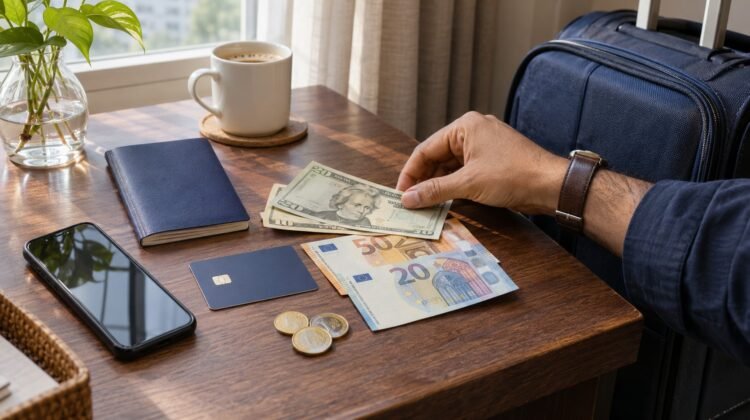
Featured image: AI-generated representative travel-money scene.
There is a familiar moment that arrives just outside an international airport: the taxi queue, the unfamiliar signage, the driver waiting, and the sudden question—Do I have enough local money? For a first-time traveller, it can feel unsettling. For a seasoned globetrotter, it is a reminder that a successful holiday is built not only on flights and hotels, but on how intelligently money is carried, spent and protected.
The golden rule is simple: never depend on one payment method abroad. A practical mix of limited cash, a prepaid forex card and an internationally enabled debit or credit card gives travellers convenience, flexibility and a financial safety net.
Where to exchange
For Indian travellers, foreign currency should be purchased through RBI-authorised banks, authorised money changers or Full-Fledged Money Changers. Online forex platforms can also be useful, provided the underlying provider is authorised and the traveller completes the required KYC process.
The hidden lesson here is that the “best rate” is not always the cheapest deal. A traveller should compare the exchange rate alongside service charges, GST, delivery or collection fees and any minimum-purchase conditions. A rate that looks attractive on a screen can lose its advantage once these costs are added.
Airport counters serve a useful purpose in an emergency, but they are rarely the best place to exchange an entire holiday budget. Buying foreign currency a few days before departure—after checking the amount needed—can save both money and last-minute stress. The Reserve Bank of India’s framework requires foreign exchange transactions to be routed through authorised persons, with applicable documentation and compliance requirements.
How much cash is enough?
There is no universal answer. A traveller staying at an all-inclusive resort with prepaid transfers needs far less cash than someone exploring local markets, using public transport or travelling independently.
A sensible starting point is to carry around 10–20 per cent of estimated discretionary spending in cash, while keeping the balance accessible through cards. This is a planning guideline, not a regulatory requirement. The idea is not to carry the maximum amount possible, but to carry enough for small payments, tips, local vendors and emergencies.
Cash remains valuable where card acceptance is limited: small restaurants, markets, local transport, public conveniences and remote destinations. But cash also has a weakness—it can be lost, stolen or left unspent. That is why it should be divided between a wallet, hotel safe and a separate emergency pouch.
Cards: convenience with fine print
A prepaid forex card is often the most disciplined option. It can be loaded with one or more currencies, used at supported merchants and ATMs, and helps travellers avoid carrying large amounts of cash. Loading currency in advance can also lock in an exchange rate, offering a measure of certainty in an unpredictable currency environment.
But the fine print matters. Issuance and reload charges, ATM withdrawal fees, inactivity charges, cross-currency conversion costs and card-replacement rules can quietly reduce the value of a “convenient” card. The deeper message is that a forex card is not automatically cheaper—it is cheaper only when its charges suit the traveller’s spending pattern.
International debit cards draw directly from a bank account and are easy to use, but foreign transaction mark-ups, ATM charges and exchange-rate spreads can make frequent withdrawals expensive. International credit cards are particularly useful for hotels, car rentals, shopping and larger purchases, and may offer rewards or travel benefits. However, interest on unpaid balances and cash-advance charges can be steep.
The lesson: choose the payment instrument for the job. Use cash for small, immediate expenses; a forex card for controlled daily spending; and a credit card for reservations, larger purchases and emergencies.

The rupee trap at the counter
One of the most expensive mistakes a traveller can make is accepting a card terminal’s offer to bill in Indian rupees instead of the local currency. This is Dynamic Currency Conversion, or DCC. It may look convenient, but the exchange rate and conversion margin can be less favourable than the rate applied by the traveller’s own bank.
The rule is simple: always choose the local currency when paying abroad. The traveller’s card issuer will handle the conversion, usually under more transparent terms.
Before departure, travellers should also activate international transactions, inform their bank if required, check ATM limits and charges, save the card issuer’s emergency helpline number and enable transaction alerts. They should never share PINs, OTPs or banking credentials, and should avoid sensitive banking activity on public Wi-Fi.
For Indian travellers, foreign exchange purchases of ₹50,000 or more must be paid through permitted banking or card channels rather than cash. Retaining the exchange receipt and purchase documentation is equally important.
Leftover currency is not lost money
Many travellers return home with unused dollars, euros, pounds or dirhams and leave them in a drawer. That is often money quietly losing value.
Under RBI provisions, a returning resident may retain foreign currency notes and travellers’ cheques up to an aggregate of US$2,000 beyond 180 days; foreign coins may be retained without a ceiling. Unspent foreign exchange can also be surrendered to an authorised dealer within 180 days of purchase, acquisition or return, subject to applicable rules.
The practical choice is straightforward: reconvert unused notes at a competitive buying rate, retain them for a future trip within permitted limits, or check whether the balance on a forex card can be retained or refunded. Prepaid travel-card balances can be redeemed on request, subject to settlement-related conditions and permitted deductions.
Travel smart, spend smarter
Currency management should never become the most stressful part of a holiday. The best approach is not to carry the most money, but to carry it wisely: some cash for convenience, a forex card for everyday spending, and an international debit or credit card for flexibility and emergencies.
For travel agents and tour operators, this is also an opportunity to add real value. A short pre-departure financial checklist—cash requirement, card activation, emergency contact, local-currency rule, insurance and leftover-currency plan—can prevent avoidable problems and elevate the customer experience.
Because the purpose of travel is to collect memories, not exchange-rate headaches.