Namibia: Where Desert, Wildlife and the Atlantic Become One Extraordinary Journey
There are African destinations where the wildlife is the headline.
And then there is Namibia, where the landscape itself becomes part of the story.
Here, a journey can move from the urban character of Windhoek to the wildlife-rich plains of Etosha, across the rugged wilderness of Damaraland and onward to a coastline where enormous desert dunes meet the cold Atlantic Ocean.
That extraordinary contrast is what makes Namibia different.
For travellers, it offers much more than a conventional safari. For travel advisors, it creates the opportunity to build an itinerary around road travel, wildlife, adventure, landscapes, photography and increasingly sought-after low-density experiences.
A Namibia journey is less about reaching one famous attraction and more about experiencing how dramatically the country changes from one horizon to the next.
Windhoek: The Gateway to Namibia
For many international visitors, Windhoek is the practical starting point for exploring the country.
Namibia’s capital combines modern infrastructure with architectural influences reflecting its history and provides a useful transition between international travel and the long road journey ahead.
For a self-drive itinerary, Windhoek can also be the place to organise a suitable 4×4, stock up on essentials and prepare for the distances involved.
That last point matters.
Namibia is enormous, and the spaces between destinations are part of the experience.
Unlike an itinerary built around short transfers between safari lodges, a road journey allows travellers to watch the scenery change gradually — from city landscapes to open plains, mountains, desert and finally the Atlantic coast.
Etosha: Namibia’s Wildlife Heart
If Namibia’s landscapes create the visual identity of the country, Etosha National Park provides one of its strongest wildlife experiences.
The park is centred around the vast Etosha Pan, a striking salt landscape that dominates the surrounding ecosystem.
During drier periods, wildlife activity around water sources can create particularly rewarding viewing opportunities.
Travellers may encounter elephants, lions, leopards, cheetahs, rhinos, giraffes, zebras, springbok, gemsbok and numerous bird species.
But Etosha feels different from many classic African safari destinations.
Its broad, open landscapes can make wildlife easier to observe against the horizon, while the immense scale of the environment gives every sighting a sense of space.
For travellers looking for an African safari with a strong landscape component, Etosha offers a compelling combination.
Damaraland: Where Wildlife Adapts to the Desert
The journey westward introduces another side of Namibia.
Damaraland is defined by rugged mountains, ancient river valleys, dry riverbeds, volcanic formations and enormous open spaces.
It is also where the relationship between wildlife and the desert becomes especially fascinating.
Desert-adapted elephants and black rhinos are among the region’s most distinctive wildlife experiences. Oryx, springbok, giraffes and other species have also developed remarkable ways of surviving in an environment where water and vegetation can be scarce.
Unlike a conventional game reserve where wildlife may be concentrated around predictable viewing areas, Damaraland’s wilderness can feel much less structured.
Sightings can be unpredictable.
That unpredictability is part of the appeal.
For travellers who value exclusivity, space and a sense of wilderness, Damaraland can be one of the most memorable components of a Namibia itinerary.
The Road Is Part of the Experience
Namibia rewards travellers who are willing to slow down.
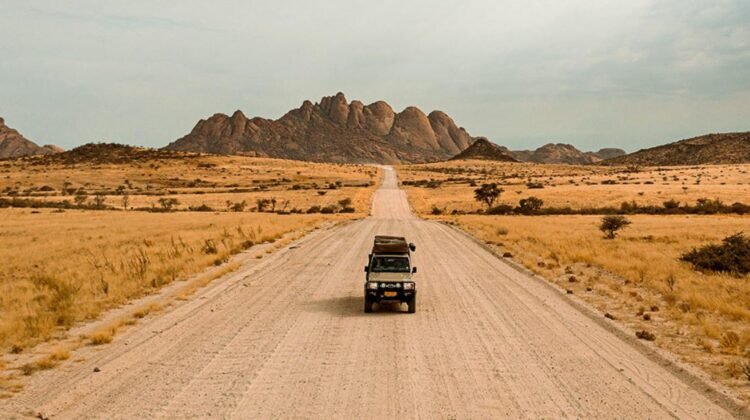
The distances can be considerable, but the road itself becomes a sightseeing experience.
Mountain ranges appear on the horizon. Desert plains stretch for kilometres. Rock formations change shape and colour. Light moves across the landscape throughout the day.
This is one reason a road-based itinerary can offer something that a purely fly-in safari cannot.
Flying saves time.
Driving reveals Namibia.
For the travel trade, that distinction is important when matching the destination to the right traveller. Namibia is particularly suited to clients who enjoy photography, scenic drives, adventure and journeys where the destination is as much about the route as the arrival.
Swakopmund: Where Desert Meets the Atlantic
Few places demonstrate Namibia’s contrasts more dramatically than Swakopmund.
The coastal town sits between the Namib Desert and the Atlantic Ocean, creating a landscape that feels almost otherworldly.
Its built environment also carries strong German architectural influences, adding another layer to the destination.
Swakopmund is more than a stopover.
It is one of Namibia’s key adventure bases.
Travellers can choose from dune-based activities such as quad biking and sandboarding, while scenic flights offer a completely different perspective of the desert.
The combination of relatively cool coastal conditions, historic architecture, restaurants and adventure activities gives Swakopmund a very different rhythm from the safari destinations further inland.
Walvis Bay: Namibia’s Marine Side
A short distance south, Walvis Bay introduces yet another dimension.
The lagoon is an important habitat for birdlife and forms the backdrop for a range of marine experiences.
Dolphin and seal cruises, kayaking, fishing and catamaran excursions allow travellers to experience Namibia from the water rather than from a safari vehicle.
Flamingos and pelicans add to the wildlife appeal around the lagoon.
This is where Namibia’s tourism proposition becomes particularly unusual.
A single itinerary can combine desert wildlife, mountain landscapes, coastal adventure and marine experiences without leaving the country.
Sandwich Harbour: Dunes Falling Into the Ocean
Among Namibia’s most dramatic landscapes is Sandwich Harbour, where towering dunes appear to descend directly towards the Atlantic.
The meeting of sand and sea creates one of the country’s most recognisable visual experiences.
For photographers and landscape-focused travellers, it is particularly compelling because the scenery changes constantly with light, wind and weather.
The destination also reinforces one of Namibia’s strongest tourism characteristics: scale.
The landscape feels immense, open and largely untouched.
The Skeleton Coast: Namibia at Its Most Remote
Further north, the Skeleton Coast adds a more remote and dramatic dimension to the journey.
The coastline is associated with rugged scenery, fog, marine wildlife and vast stretches of wilderness.
The nearby Cape Cross area is particularly known for its Cape fur seal colony, where thousands of seals can gather along the Atlantic coast.
For travellers who have already experienced Etosha’s wildlife, the Skeleton Coast offers an entirely different type of encounter.
Here, the ocean, wind, desert and wildlife create the experience.
Why Namibia Works for Adventure and Luxury Travel
Namibia has traditionally appealed strongly to independent travellers, photographers and adventure seekers.
But its vast landscapes and low-density tourism model also create opportunities for premium travel.
Luxury lodges, private guides, scenic flights and carefully designed 4×4 journeys can turn the same landscape into a highly personalised experience.
This makes Namibia particularly relevant to the growing demand for experiential luxury — where exclusivity is defined not simply by a five-star room, but by access, space, privacy and the quality of the experience.
A Destination Built Around Contrast
Namibia’s greatest strength may be its ability to change character repeatedly during a single journey.
Windhoek provides the gateway.
Etosha brings wildlife.
Damaraland delivers rugged wilderness.
Swakopmund combines heritage and adventure.
Walvis Bay introduces marine experiences.
Sandwich Harbour delivers one of Africa’s most dramatic desert-and-ocean landscapes.
The Skeleton Coast adds remoteness.
Together, they create a destination that is difficult to reduce to one tourism category.
It is a safari destination.
It is an adventure destination.
It is a road-trip destination.
It is a photography destination.
And increasingly, it is a destination for travellers seeking space and experiences away from conventional mass tourism.
The Verdict
Namibia is best understood not as a single attraction but as a journey through extremes.
The country’s greatest tourism asset is the way its landscapes continually change — from wildlife-rich plains and ancient mountains to desert dunes and the cold Atlantic.
For travellers, that makes Namibia one of Southern Africa’s most distinctive experiences.
For travel professionals, it offers something equally valuable: the ability to build highly individual itineraries around the traveller’s interests rather than around a single iconic attraction.
The real magic of Namibia is not simply what waits at the end of the road.
It is everything you discover while travelling there.