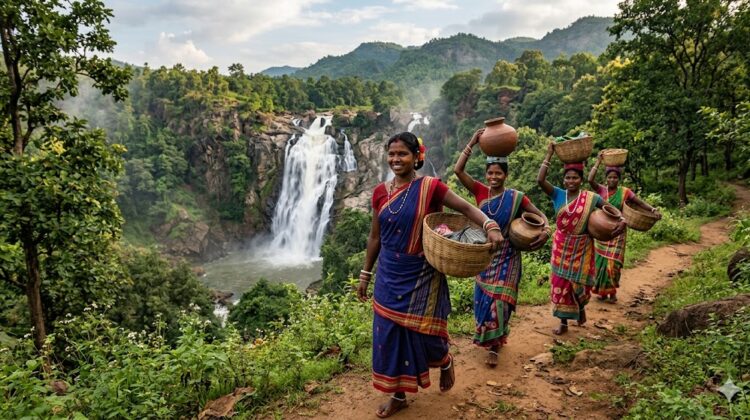
Jharkhand Bets Big on Eco-Tourism, Community Travel and Low-Impact Growth
Jharkhand Bets Big on Eco-Tourism, Community Travel and Low-Impact Growth
Jharkhand is quietly rewriting its tourism story. Backed by a bigger state budget, new eco-friendly attractions and a stronger focus on local participation, the state is positioning itself as one of India’s most promising sustainable tourism destinations.
For the travel trade, the shift is important because it combines infrastructure, conservation and community livelihoods in one model. Instead of chasing unchecked mass tourism, Jharkhand is starting to frame its forests, waterfalls, plateau terrain and village economies as the foundation of a more responsible growth strategy.
The budget signal is hard to ignore
The most visible sign of Jharkhand’s intent is financial. In the Abua Dishom Budget 2026–27, the state has allocated ₹361.67 crore to the tourism, art, culture, sports and youth affairs department, up from ₹336.64 crore in 2025–26, marking a rise of 7.43%.
The bigger message is not just that tourism is getting more money, but that it is being treated as part of a broader economic revival strategy.
The long-term trend is equally significant. Tourism revenue expenditure in Jharkhand touched ₹889.02 million in 2026, compared with ₹582.71 million in 2025, reflecting a sharp year-on-year jump and one of the strongest commitments the state has made to the sector in recent years.
For a state often overlooked in mainstream tourism conversations, this is a clear policy signal: Jharkhand wants a serious place on India’s sustainable travel map.
Access without overbuilding
Jharkhand’s tourism plan is not following the usual model of heavy concrete development. Instead, the state is trying to make natural attractions more accessible without damaging the surroundings.
That is why projects such as glass bridges at Dassam and Jonha waterfalls, and skywalks at Patratu and Magnolia Point, have become part of the conversation. The idea is to improve visitor experience while preserving the landscape.
Community-led tourism moves to the buffer zones
The most important shift may be happening around Dalma Wildlife Sanctuary. Spread across about 195 square kilometres near Jamshedpur, Dalma is already known for its elephant corridor and forest ecosystem. Rather than turning the area into a resort-heavy tourism zone, the state is promoting village home-stays in the buffer areas.
That decision matters because it changes who benefits from tourism. Instead of revenue flowing mainly to outside investors, local families can earn directly from hosting visitors, providing meals, guiding experiences and supporting forest-based travel.
For tribal and rural communities, this kind of model can create durable income without forcing large-scale land conversion. It also fits the larger conservation story: low-impact tourism infrastructure can support controlled visitor movement while protecting biodiversity.
Dumka adds an education layer
Dumka adds another layer to this story. The newly inaugurated Chutonath Biodiversity Park, developed at a cost of ₹10 crore over two years, covers 3.5 hectares at the foot of the Chutonath Temple.
This is not just another park for casual footfall; it is being positioned as a space for environmental awareness and learning. By combining native plant species, educational models and easy access from a heritage site, the park creates a simple but effective tourism idea: teach while you host.
That makes it especially useful for school groups, student travellers and families looking for meaningful short breaks. It also strengthens the local economy by encouraging longer stays and more spending in surrounding businesses.
Eastern India gets a wider tourism push
Jharkhand’s tourism ambitions are also being supported by the Centre’s Purvodaya initiative, under which five tourism destinations across the eastern states are being developed. Jharkhand is expected to be one of the beneficiaries, which could help the state gain visibility beyond its traditional markets.
Connectivity is the other key piece. The planned induction of 4,000 electric buses across the region supports the idea of cleaner movement between destinations. For tourists, that could eventually mean easier and greener access to Jharkhand’s waterfalls, forests and cultural sites.
What it means for the travel trade
For the B2B fraternity, Jharkhand’s tourism play is worth watching closely. The state is not trying to become a mass-market resort destination. Instead, it is building a portfolio around nature, community, education and controlled access.
That makes it a better fit for curated itineraries, school travel, eco-tourism circuits and experiential domestic products. It also opens room for DMCs, operators and destination marketers who can package places with a strong narrative.
In today’s market, travellers are increasingly looking for destinations that feel authentic, responsible and different from the usual circuit. Jharkhand is beginning to speak that language clearly.
The larger point is simple: if the state continues on this path, it could emerge as a model for sustainable tourism in India’s east — not by overwhelming nature, but by working with it.