

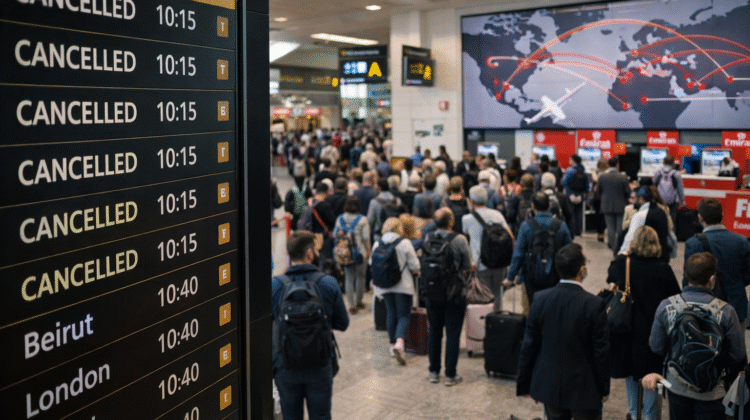
Middle East Crisis Disrupts Global Travel: Airfares Surge Up to 300%
The ongoing Iran–US conflict has sent shockwaves across global aviation, pushing airfares to unprecedented levels and forcing airlines into rapid operational shifts. What was once a stable and efficient global air corridor has now become one of the most volatile zones in international travel.
Major carriers including Emirates, Qatar Airways, Etihad, Lufthansa, British Airways, Air India, and Qantas are rerouting flights, cutting frequencies, and adjusting pricing structures in response to escalating geopolitical tensions.
The Numbers That Hurt
Airfares on key Europe–Asia routes have surged by as much as 300%.
- A ₹80,000 ticket has jumped to nearly ₹3.2 lakh
- Business travel budgets are under pressure
- Leisure travel demand is seeing immediate drop-offs
For Indian travellers, especially those flying to Europe or transiting through the Middle East, this surge is a significant financial and logistical setback.
Why This Is Happening
Airlines are currently dealing with a triple operational shock:
- Rising fuel costs driven by geopolitical instability
- Airspace restrictions and closures, forcing longer, fuel-intensive routes
- Heightened security protocols, increasing turnaround times and operational costs
Gulf carriers such as Emirates, Qatar Airways, and Etihad are particularly vulnerable, as their hub-and-spoke model relies heavily on seamless Middle Eastern airspace connectivity.
The Ripple Effect on Global Tourism
The disruption is not limited to aviation—it is cascading across the entire travel ecosystem.
Hotel bookings in Dubai and Abu Dhabi are softening
- European destinations like London, Paris, and Rome are reporting fewer Indian arrivals
- Tour operators are seeing cancellations and delayed bookings
The result: a measurable slowdown in tourism-driven economies that depend on long-haul connectivity.
What Frequent Flyers Must Do Now
In this volatile environment, travel planning requires a strategic approach:
- Book Early: Prices are rising rapidly—last-minute bookings are extremely expensive
- Explore Alternate Gateways: Consider cities like Mumbai, Jaipur, or Abu Dhabi for better pricing
- Prepare for Longer Journeys: Expect extended flight durations and layovers
- Track Flights in Real Time: Stay updated on delays, reroutes, and cancellations
- Leverage Loyalty Programs: Use miles to offset rising costs or upgrade comfort
- Review Travel Insurance: Ensure coverage includes geopolitical disruptions
Security Reality Check
Passengers should prepare for tighter airport security worldwide.
- Arrive at least 3 hours before international departures
- Expect longer queues and stricter checks
- Keep documents and itineraries easily accessible
Airports are prioritizing safety, which means longer processing times are now the norm.
Industry Adaptation Underway
The aviation and travel industry is already adjusting to this new reality:
- Airlines are exploring alternative flight corridors
- Increased focus on fuel efficiency and cost optimization
- Travel companies are revising pricing models and packages
In the long term, this crisis may accelerate structural changes in global aviation networks.
Strategic Takeaway for Travel Businesses
This is not just a disruption—it’s a reset moment.
- Build partnerships with Asian carriers like Singapore Airlines and Cathay Pacific as alternatives to Gulf hubs
- Prepare clients for higher costs and longer travel times
- Speed up response cycles—48-hour turnaround is becoming standard
- Make conflict-inclusive travel insurance mandatory
A New Reality for Global Travel
The message is clear: travel is becoming more complex, more expensive, and more unpredictable.
For travelers and businesses alike, adaptability is no longer optional—it is essential.
In a world shaped by geopolitical uncertainty, those who plan smarter, move faster, and diversify their strategies will stay ahead.
These articles are part of our ongoing coverage of emerging travel trends affecting the Indian B2B travel industry. For collaboration, advertising, or content partnerships, contact our editorial team …INFO@THETRAVIGATOR.COM.