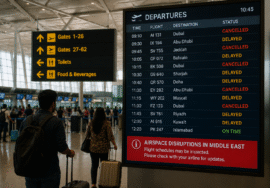

Middle East Conflict Impacts Regional Tourism
The ongoing West Asia crisis is severely disrupting tourism across the Middle East:
Widespread Hotel Cancellations: Egypt, Jordan, Bahrain, Saudi Arabia, Qatar, and Israel are experiencing massive hotel booking cancellations for March and April 2026. Over 37,000 flights were cancelled in the first nine days of March alone .
Estimated Losses:
Egypt: Daily tourism losses estimated at $35–40 million; Red Sea resorts report 20–30% cancellations; spring bookings down 35% .
Jordan: Petra bookings reached 100% cancellations in March; 60% of April and 45% of May reservations have been wiped out .
Israel: Ben Gurion Airport’s closure has been extended until April 16, with major carriers (Delta, Lufthansa, Air France) suspending services indefinitely .
Qatar: Hamad International Airport faced full suspension; Qatar Airways saw an 81% cancellation rate in early March .
UAE has lost 1.6 percentage points in its Share of Searches Index compared to the same period in 2025—the steepest decline among Gulf nations. Similar contractions are observed in Qatar, Kuwait, and Bahrain , while Oman shows a more moderate but still negative drop .
According to Tourism Economics (Oxford Economics), inbound travel to the Middle East could decline by 11% to 27% in 2026 compared to pre-conflict forecasts, translating to 23 million to 38 million fewer international visitors and a loss of $34 billion to $56 billion in tourism spending . The WTTC estimates the region is losing approximately €515 million (approx. $560 million) per day
This report is part of TheTravigator’s continuing news coverage of the travel, tourism, aviation, and hospitality sectors. Our editorial team publishes industry news, market insights, partnerships, policy developments, and business updates relevant to the travel trade community. For press releases, partnership opportunities, advertising enquiries, or editorial collaborations, please contact our editorial desk at:
INFO@THETRAVIGATOR.COM