Infrastructure & Transport: The Enabler Reshaping Delhi’s Tourism Economy
Introduction
Tourism doesn’t scale on marketing alone—it scales on movement.
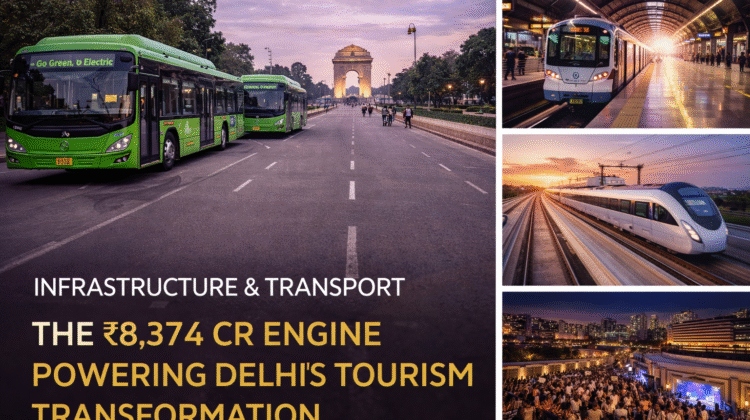
With a massive ₹8,374 crore allocation toward transport and mobility, Delhi is addressing the most critical layer of tourism infrastructure: how people move within and beyond the city.
From EV buses to metro expansion and high-speed rail corridors, this is not incremental improvement—it’s a mobility reset that directly impacts the travel trade.
Insights
For travelers, infrastructure defines experience more than attractions do.
Delhi’s push toward green, congestion-free mobility—including EV fleet expansion to 5,800 buses by FY27 and a long-term target of 12,000—signals a move toward cleaner, smoother urban travel.
At the same time, investments in Metro Phase IV & V and RRTS (NaMo Bharat corridors) are reshaping how quickly travelers can navigate the NCR and surrounding regions.
The bigger shift, however, is regional. With the proposed Delhi–Varanasi high-speed rail corridor, travel time between key tourism hubs could shrink dramatically—turning long-haul domestic circuits into fast, sellable itineraries.
Industry Analysis
For B2B stakeholders, this is where infrastructure becomes direct revenue enablement.
Last-mile connectivity has long been a friction point in Indian tourism. Improved metro reach and EV bus networks reduce dependence on private transfers, making Delhi more accessible for:
- Independent travelers (FITs)
- Small curated groups
- Budget-conscious international visitors
The real upside lies in regional circuit creation.
With RRTS corridors like Delhi–SNB and Delhi–Panipat–Sonipat, and future high-speed rail connectivity, operators can now design:
- Delhi–Agra–Jaipur (Golden Triangle) with faster turnaround
- Extended circuits like Delhi–Varanasi without logistical fatigue
Reduced travel time directly improves:
- Itinerary efficiency
- Customer satisfaction
- Conversion rates for international clients with limited time
From a MICE perspective, improved connectivity expands Delhi’s reach into the broader NCR and North India region—making it easier for delegates to attend events without friction. This strengthens Delhi’s position as a centralized corporate hub.
Strategic Takeaway
Infrastructure should now be used as a sales lever, not just a background advantage.
The winning pitch is:
“Travel faster, experience more—Delhi as your seamless gateway to North India.”
For agents and DMCs:
- Build multi-city itineraries leveraging faster rail and RRTS connectivity
- Promote Delhi as a base hub for regional exploration
- Target FIT and small-group segments with improved public transport accessibility
This is a conversion booster—shorter travel times mean easier selling.
Verdict
Delhi’s infrastructure push is not just about urban development—it’s about tourism scalability.
By reducing friction in movement, the city is unlocking:
- More efficient itineraries
- Higher tourist satisfaction
- Stronger integration with regional destinations
For the travel trade, the implication is clear:
better connectivity doesn’t just move people—it moves business.
This report is part of TheTravigator’s continuing news coverage of the travel, tourism, aviation, and hospitality sectors. Our editorial team publishes industry news, market insights, partnerships, policy developments, and business updates relevant to the travel trade community. For press releases, partnership opportunities, advertising enquiries, or editorial collaborations, please contact our editorial desk at:
INFO@THETRAVIGATOR.COM