

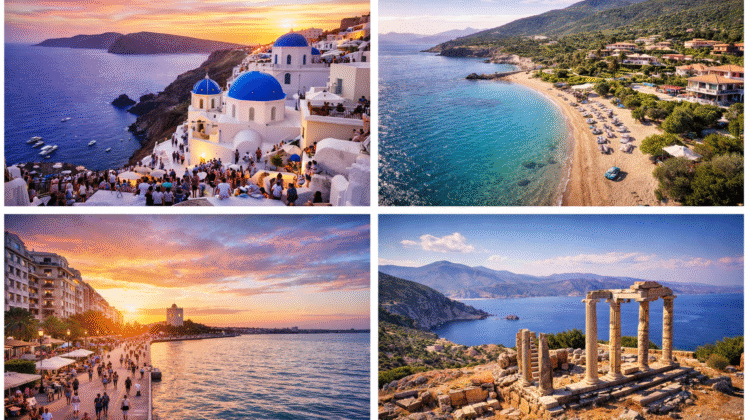
Greece: How Indian Travelers Can Have Santorini Magic Without the Crowds
Introduction
Few destinations hold the same aspirational pull for Indian travelers as Greece. The imagery is deeply embedded—whitewashed villages, blue domes, and dramatic sunsets. And at the center of it all sits Santorini, the poster child of Mediterranean luxury.
But success has created its own problem. Santorini and Mykonos are now operating at full capacity, pushing prices up and flexibility down. For Indian outbound, the question is no longer whether to sell Greece—it’s how to sell it smarter.
Insights
Indian travelers aren’t just buying a destination—they’re buying a visual promise. And while Santorini delivers that promise, it’s no longer the only place that can.
Mainland regions like the Peloponnese offer a similar Mediterranean aesthetic—coastal drives, boutique resorts, and heritage sites—without the density and pricing pressure of the islands.
Meanwhile, Thessaloniki introduces a more urban, cultural dimension. It works particularly well for Indian itineraries that want to balance leisure with exploration—food, history, and waterfront living in a far more accessible format.
The key shift is psychological: travelers are becoming more open to “Greece beyond the postcard”, especially when positioned as a more relaxed and exclusive experience.
Industry Analysis
The island inventory crisis is very real. Santorini and Mykonos are facing:
- Severe hotel capacity constraints
- Escalating room rates
- Limited flexibility for group movements
For Indian operators, this directly impacts margins—especially for large groups and MICE business.
The solution lies in segmentation:
- Mainland Greece for groups → better inventory, smoother logistics, stronger margins
- Islands for luxury FITs and weddings → but only with early planning and strong supplier control
From a B2B standpoint, the mainland is still under-leveraged. It offers:
- Greater negotiating power with hotels
- Lower operational complexity (no ferries, fewer transfers)
- The ability to scale group travel without compromising experience
On the other hand, the islands are moving toward exclusivity-driven supply. For Indian luxury FITs, access increasingly depends on deep DMC relationships and early block bookings.
Weddings remain a major opportunity—but with a clear shift:
venues now need to be secured 18–24 months in advance, especially in Santorini.
Strategic Takeaway
Greece should be repositioned from a single-island dream to a layered destination strategy.
The winning pitch is:
“Santorini for the dream, mainland Greece for the experience.”
For agents and DMCs:
- Use mainland Greece (Peloponnese / Thessaloniki) for group scalability and margin protection
- Reserve Santorini/Mykonos for premium FIT and wedding segments only
- Lock island inventory well in advance (18–24 months) for high-value clients
This dual approach allows operators to retain the aspirational pull of Greece while fixing its commercial challenges.
Verdict
Greece isn’t losing demand—it’s evolving into a more complex, segmented market.
The islands will always remain the dream, but the mainland is where the business case strengthens. Operators who continue to rely solely on Santorini risk margin erosion and operational strain.
Those who pivot intelligently will unlock a more sustainable model:
sell the dream—but build the itinerary where it actually works.
This article is part of TheTravigator’s ongoing editorial coverage of trends, developments, and business opportunities within the Indian travel and tourism industry. Our editorial content is intended to inform travel professionals, industry stakeholders, and partners about market movements, policy changes, partnerships, and innovation shaping the sector. For editorial collaborations, advertising opportunities, press releases, or content partnerships, please contact our editorial team at:
INFO@THETRAVIGATOR.COM