



The Second Lung: Why Delhi’s New Airport Is the Most Important Slab of Concrete in India
For the last decade, flying out of Delhi’s Indira Gandhi International (IGI) Airport felt less like travel and more like a contact sport. You fought the traffic on the NH-8, you fought the queues at T3, and you fought for a chair at the boarding gate.
As of January 2026, the pressure valve has finally cracked open. The Noida International Airport (DXN) in Jewar is operational.
It is shiny, it is massive, and it is located so far from Central Delhi that you might as well be driving to Jaipur. But make no mistake: this is the most critical piece of infrastructure to hit North India since the Metro.
The “Far” East
Let’s get the geography straight. This airport isn’t in Noida; it is in Jewar. That is a solid 75km from Connaught Place.
- The Drive: If you live in South Delhi, stick to IGI. Driving to Jewar takes 90 minutes on a good day and “forever” on a bad one. The promised high-speed rail link is still playing catch-up, so for now, you are at the mercy of the Yamuna Expressway.
- The Optics: It is a sterile island of glass surrounded by farmland that is rapidly being eaten by real estate sharks. The “Aerocity” they are building around it feels like a rendering that hasn’t finished loading yet. It is dusty, desolate, and utterly lacking in soul.
The Relief
But once you step inside, the cynicism evaporates. DXN is designed to correct every mistake IGI made. It is fully digital from day one.
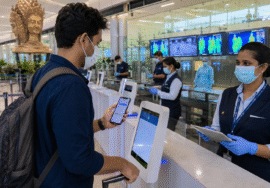
- The Flow: The “DigiYatra” face-scan system here isn’t a beta test; it is the default. You walk from the curb to the gate without touching a boarding pass.
- The Silence: It is quiet. The ceilings are high, the light is natural, and it lacks that frantic, claustrophobic energy of T3. For the millions of people in Greater Noida, Ghaziabad, and Agra, this is a liberation. They no longer have to cross the “Gas Chamber” of Delhi to catch a flight.
The Ayodhya Connection
Here is the real story that the business papers are missing. DXN isn’t just relieving Delhi; it is feeding Ayodhya. With the Ram Mandir complex pulling in over 20 crore visitors last year (a number that breaks every global tourism record), the existing infrastructure in UP was buckling. Jewar is the new funnel.
- The Shift: International pilgrims are now landing here and taking the expressway or the Vande Bharat trains straight to the temple town, bypassing the capital entirely. It is re-orienting the entire tourism map of North India away from the “Golden Triangle” and towards the “Spiritual Belt.”
India in 2026 is a country building at the speed of light while still choking on its own dust. The air in Delhi this month is still hazardous (AQI 450+), and the Yamuna is still frothy. But standing in the terminal of Jewar, watching a plane take off from what used to be a wheat field, you feel the momentum.






Dear you should have given driving directions from famous delhi landmark.
is it safe at night ?